National Treasure
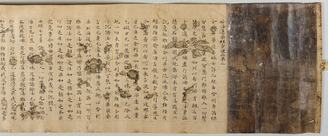
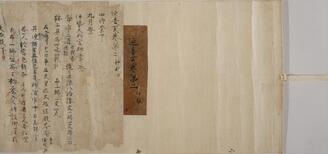
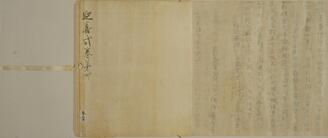
Tale of Flowering Fortunes
栄花物語
Calligraphy & Books · Kamakura, 1201–1300Kyushu NM
Home › Browse › Calligraphy & Books › Heian period › “Ware mite mo” from the Tsugishikishi poetry anthology
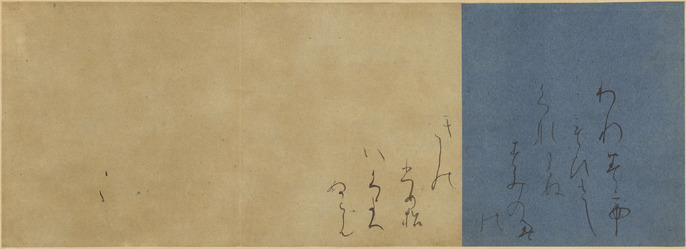
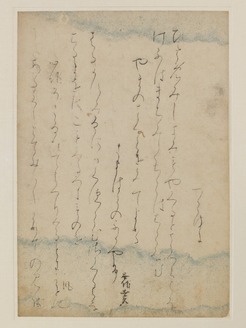
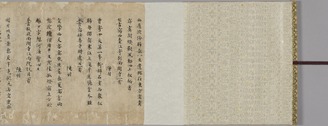
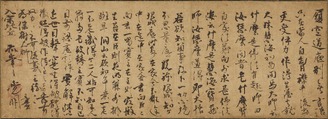
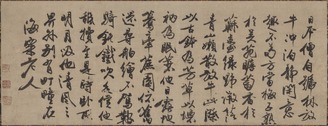
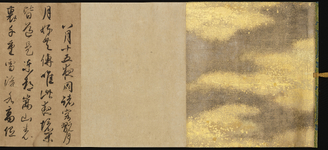
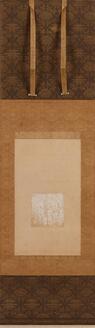
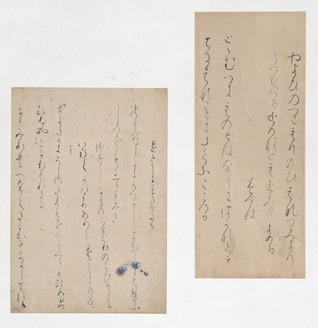
Compiled in the middle of the Heian period (about 794–1185), the Tsugishikishi anthology originally existed as a square-shaped book of colored papers bound in a style called decchō. The beautiful calligraphy contained within inspired admirers to later divide it up to add parts to their own collections. This work is composed of three pages that were collated and mounted onto a hanging scroll. It features an anonymous poem from volume 17 of the Kokin Wakashū anthology: “Ware mite mo / hisashiku narinu / Suminoe no / kishi no himematsu / ikuyo e nuran”. It roughly translates as, “This beautiful pine on the shore of Suminoe, ancient even to me—how many ages must it have experienced?”. The poem is rendered in many long, unbroken strokes on one sheet each of dark and light indigo paper. Another feature of this calligraphy is the way the lines do not start at the same vertical position on the paper, a style known as chirashi-gaki, or scattered writing.
By varying the starting points of each line, meaning is given to the negative space left above the words, thereby expressing a sense of artistry. When presented to Emperor Gomizuno’o in the early Edo period (1603–1868), it was declared the work of Ki no Tsurayuki (d. 945). Accompanying documents indicate that it had been passed down through the Nakai family, who served as the Edo shogunate’s Kyoto-based daikugashira, or officials in charge of the carpentry bureau. Both its confirmed provenance from Japan’s early modern period (1600–1800) and the way it clearly illustrates the respect given to ancient calligraphy during the same era makes this work a valuable historical source worthy of being included in a national museum’s collection.
— Museum description: Kyushu National Museum (CC BY 4.0), via ColBase / Japan Search.