National Treasure

Tale of Flowering Fortunes
栄花物語
Calligraphy & Books · Kamakura, 1201–1300Kyushu NM
Home › Browse › Calligraphy & Books › Nanbokuchō period › Calligraphy by Feng Zizhen: On Hōgyū Kōrin

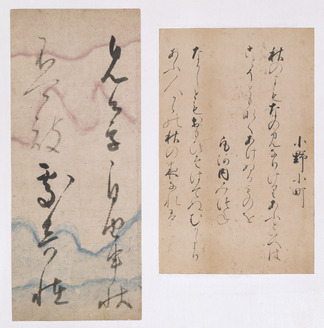
Hōgyū Kōrin (1289–1373), who was given this calligraphic work, was a Japanese Zen priest of the Rinzai sect during the Kamakura period (1192–1333) and the Nambokuchō period (1336–92). He was born in Chikuzen (present-day Fukuoka) and went to China on a trading ship in the second year of the Bunpō era (1318). In China, which was under the reign of the Yuan dynasty (1271–1368), he practiced Zen under eminent Zen masters and returned to Japan in the first year of the Shōchū era (1324). Hōgyū Kōrin subsequently served as the head priest of various Zen temples including Kenchō-ji, Kennin-ji, Tenryū-ji, and Nanzen-ji, thereby contributing to the promotion of Zen in Japan. At the age of 41, he was presented a poem by Mingji Chujun (1262–1336), a Chinese Zen master who came to Japan in the fourth year of the Karyaku era (1329). The calligrapher, Feng Zizhen (1257–1327?), was a government official of the Yuan dynasty. He was talented in calligraphy but was better known for excelling in poetry. Although he remained a lay Buddhist, he practiced Zen under Zhongfeng Mingben (1263–1323), a leading Zen master during the Yuan dynasty. Feng Zizhen also enjoyed a friendship with another leading Zen master, Gulin Qingmao (1262–1329) and wrote the preface to the master’s book.
As a member of the Zen world in the Yuan dynasty, Feng Zizhen should have enjoyed contacts with Japanese monks who came to China to learn Zen. This fact is evidenced in this work, which he presented to Hōgyū Kōrin, as well as the calligraphic writing that he gave Muin Genkai (?–1358) (Important Cultural Property, the Gotoh Museum). The poet expresses here his expectations of Hōgyū Kōrin, a young Japanese monk in his 20s. The poet compares the young man to a ripening plum fruit and senpuku, a plant that will bloom with fragrant flowers. It is hoped that like them, Hogyu Korin would reveal his potential as a Zen priest and achieve great things. The calligraphy features powerful and fluid brushstrokes written with the tip of the brush. Among the known works by Feng Zizhen, this was probably created during his 60s and features relatively large characters. Although Feng Zizhen was a lay Buddhist, in Japan his works are regarded as “bokuseki” (calligraphic writing by a senior priest of Zen Buddhism).
— Museum description: Kyushu National Museum (CC BY 4.0), via ColBase / Japan Search.