National Treasure

Tale of Flowering Fortunes
栄花物語
Calligraphy & Books · Kamakura, 1201–1300Kyushu NM
Home › Browse › Calligraphy & Books › Heian period › Fragment of a Tang Chinese poetry anthology
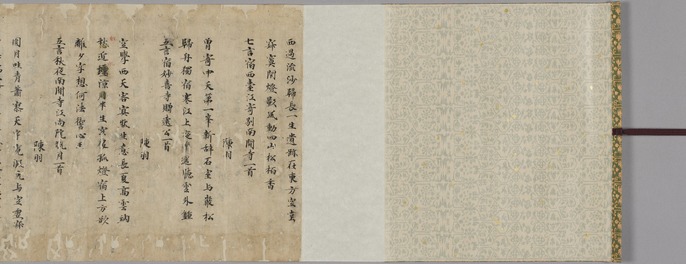
“Pages from the Anthology of Chinese Poems” comprises of a collection of poems from the Tang dynasty (618–907). During the Heian period (794–1192), the collection was introduced to Japan although the beginning and ending sections are now missing. Since paper was precious back then, the reverse side of the paper in this collection was used for transcribing the 22nd volume of the Anthology of Poems of Bai Juyi in the Changquing era in China. Comprising six sheets of paper, the fragments contain a total of 27 Chinese poems composed during the early to mid-Tang dynasty (618–907). Each poem comprises eight lines, and each line has either five or seven Chinese characters. The themes mainly concern Buddhist temples. Poets include Zhen Yu, Li Jiayou, Su Weidao, Liang Wang San Wei, Cui Dong, Wang Jian, Meng Haoran, Lang Shiyuan, and Gao Shi, who were active from the early to mid-Tang dynasty. Some poets used Chinese characters enacted by Empress Wu Zetian (r. 690–705). Based on the active periods of the poets, the collection of poems was probably transcribed toward the end of the Tang dynasty (9th century). The characters are written between faint black lines and look solemn. The kaisho (square) writing style with the characters written quickly give an impression of the semi-cursive style. The rigid turns in the brushstrokes here are linked to the calligraphic style of the Buddhist sutras transcriptions in the late Nara period (710–94).
The transcription on the backside features a Japanese calligraphic style developed after the mid-Heian period. Bai Juyi (772–846) was a poet active in the mid-Tang dynasty and the anthology was compiled in the fourth year of the Changquing era in China (824). In the fifth year of the Jōwa era (838), Fujiwarano Okamori, the governor of Dazaifu, found a transcription of this collection in a trade ship in the Hakata harbor. He presented the transcription to Emperor Ninmyō. Japanese court nobles in the Heian period found that the poems of Bai Juyi resonated with their sensitivity and aesthetic sensibility. The poems contributed to the development of Japanese literature. The 38 poems in volume 22 in this anthology are usually separately found in volumes 13, 14, 16, and 17. There are also differences in the text. These provide an important clue for determining the original composition of the anthology. The calligraphic style of the poems in this transcription resembles the kōzeiyō (Fujiwara Yukinari’s style). The brushstrokes, however, suggest that the transcriber was not an excellent master calligrapher and was occasionally careless, particularly when transcribing the latter half.
— Museum description: Kyushu National Museum (CC BY 4.0), via ColBase / Japan Search.


