National Treasure
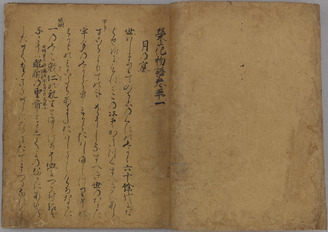
Tale of Flowering Fortunes
栄花物語
Calligraphy & Books · Kamakura, 1201–1300Kyushu NM
Home › Browse › Calligraphy & Books › Heian period › Scroll segments no. 4 from the Anthology of Ancient and Modern Japanese Poems, vol. 2; one of the Kameyama Segments
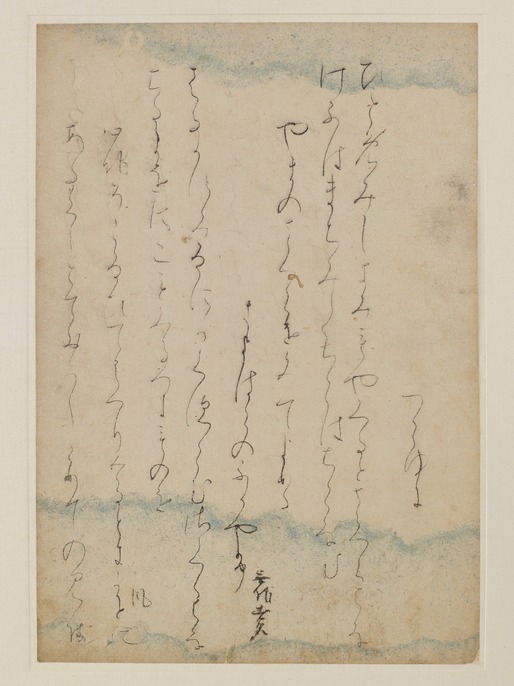
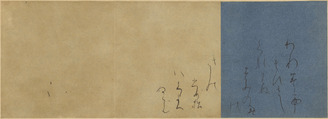
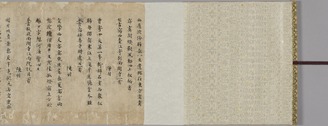
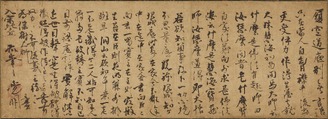
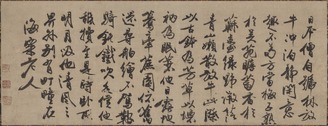
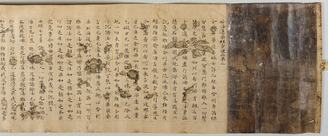
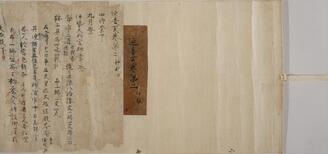
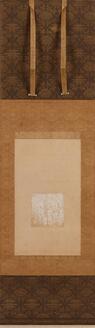
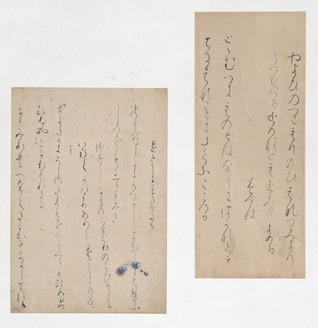
During the early 10th century, the Kokin Wakashu (Collection of Japanese Poems of Ancient and Modern Times) was compiled and presented to the Emperor Daigo (885–930). As per the preface written by Ki no Tsurayuki in kana in the Japanese order, the collection was revolutionary since it used kana , which were developed from Chinese characters in Japan only shortly before the compilation of the Kokin Wakashū. The original manuscript did not survive. The oldest known transcription is the “Kōya-gire”, which was produced around 1050, more than 150 years after the original manuscript. Kōya-gire features refined and graceful kana. This work, Kameyama-gire, was transcribed toward the end of the 11th century. The brushwork is refined, comprising of delicate and flowing lines. Since several kana are written in a single stroke, they look like a thin curving line following down the paper. This continuous writing style is both practical and artistic. The lines look as if they are creating a beautiful harmony by resonating with each other.
The paper used here is decorated by uchigumori and kirazuri techniques. The uchigumori creates a cloudiness between two sets of clouds of the page with the following steps: first indigo or purple sheets of paper are soaked and dissolved into fibers; the fibers are then superimposed along the upper and lower borders symbolising clouds (in this work only along the lower border) of another sheet of paper. Whereas kirazuri is a technique to scatter minute mica powder on a sheet of paper. This work uses both techniques to represent the sky and to blend with the calligraphic style. These convey the aesthetic sense of the court nobles during the mid-Heian period (794–1192). Kameyama-gire contains 39 poems that were originally in volumes 2 and 4 of the “Kokin Wakashū.” It was passed down in the Matsudaira family of the Kameyama domain in Tamba (present-day Kyoto) during the Edo period (1603–1868) and came into the hands of Masuda Don-nō after the Meiji Restoration (1868).
— Museum description: Kyushu National Museum (CC BY 4.0), via ColBase / Japan Search.