National Treasure

Tale of Flowering Fortunes
栄花物語
Calligraphy & Books · Kamakura, 1201–1300Kyushu NM
Home › Browse › Calligraphy & Books › Kamakura period › Calligraphy by Daitō Kokushi (Shūhō Myōchō): Buddhist teachings (known as the Kogarashi bokuseki)
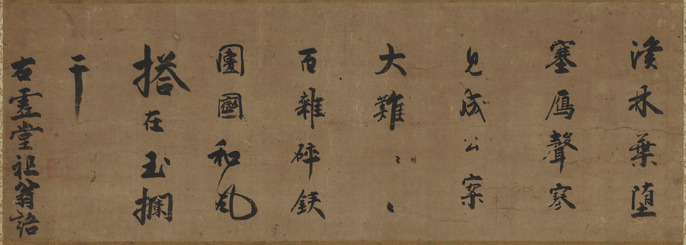
Shuho Myocho (1282–1337) was a Japanese high priest of the Rinzai sect of Zen Buddhism from the Kamakura (1192–1333) to Nambokuchō period (1336–92). He studied under Nampō Jōmin, a Japanese priest who practiced Zen under Xutang Zhiyu in China during the Southern Song dynasty (1127–1279). Among the followers of Shūhō Myōchō were Emperor Hanazono and Emperor Go-Daigo. Both emperors granted him the title of kokushi (a high priest who preached Buddhism to the emperor). His honorific title “Daitō Kokushi” was derived from “Kōzen Daitō Kokushi,” which was granted by Emperor Hanazono. Shūhō Myōchō founded Daitoku-ji temple in northern Kyoto. The term jōdō, which is contained in the title of this work, refers to preachings delivered by a high priest on the platform in the Hattō (main hall) of a Zen temple. This work represents the jōdō delivered by Xutang Zhiyu at Baoen temple in Zhejiang, China. The text was written by Shūhō Myōchō. Most of the jōdō were delivered in a poetic form. Many calligraphic writings by Zen priests represent these poetic preachings and specific titles are given to important pieces.
The title of this work “Kogarashi” (first cold blast) derives from the two initial phrases: leafless trees and the sorrowful voice of wild geese, which represent a landscape in late autumn. These two phrases are followed by the teaching: “Smash your delusions and earthly desires, and you will feel the spring breeze and your world expand.” The calligraphic writing style here features block Chinese characters free from the influence of the Japanese style. The brushwork, characterized by considerable writing pressure and rigorous strokes, is typical of the style of Zen priests who traveled back and forth between Japan and China. At the same time, larger characters, such as “搭” and “干” represent the priest’s daring character. Nampō Jōmin, the teacher of Shūhō Myōchō, served as the head priest of Sōfukuji temple in Dazaifu for 30 years. With the permission of Emperor Go-Daigo, Shūhō Myōchō also served as the head priest of the same temple for 100 days when he was 50 years old. These reflect the deep relations between Xutang Zhiyu and Dazaifu.
— Museum description: Kyushu National Museum (CC BY 4.0), via ColBase / Japan Search.