National Treasure
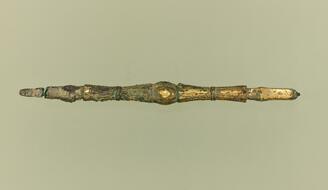
Shiketsu (Posts Erested at Four Corners of Alter to Rope off Sanctuary), Gilt bronze
独鈷
Metalwork · Heian, 12th centuryTNM
Home › Browse › Metalwork › Heian period › Butterfly-Shaped Ritual Gong (Kei)
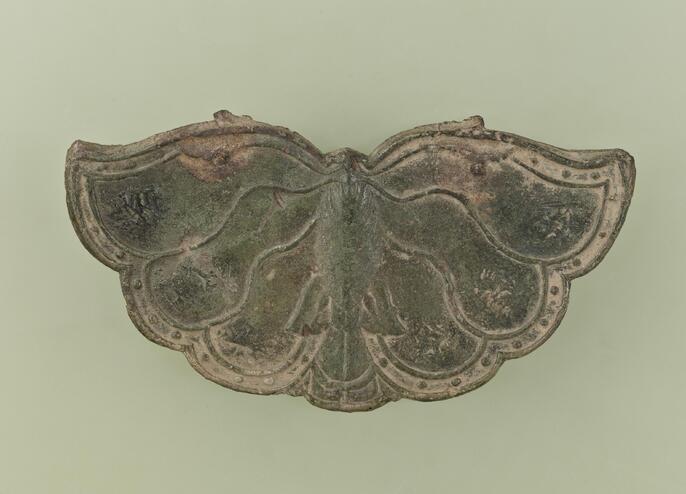
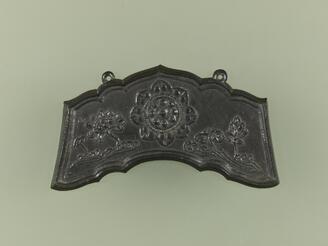
Kei gongs are ritual instruments used in Buddhist ceremonies. They are rung by priests to mark the different stages of the ceremony. They are still widely used in temples to this day. If you visit the main hall of a temple, you will see several seats for priests lined up before the Buddhist statue. You may also see a kei gong like this hanging down close to the seats. The gong will produce a high-pitched chime when struck in the center. Kei gongs were originally made of stone and used as musical instruments in ancient China. These instruments were made by taking highly-resonant stone materials and sculpting them into shapes resembling triangles with unequal sides. Several gongs of different sizes were hung in a row to produce different musical notes when struck. It is not known how these instruments came to be incorporated into Buddhist ceremonies. Most kei gongs used in Japanese Buddhism are made of cast bronze rather than stone, and they are shaped like an inverse “V” rather than an unequal triangle.
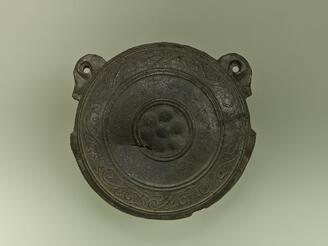
However, some are shaped like lotus flowers or butterflies. This kei gong is made of cast bronze and is shaped like a butterfly. Bronze is used because it produces a good sound. The gong features arabesque patterns around seven conjoined circles. It was discovered in 1939 alongside another ritual instrument known as a waniguchi gong. This waniguchi gong is inscribed with the date 1001. Though the two gongs have different shapes, they are both made of bronze and used in Buddhist ceremonies to produce chiming sounds. They also feature the same combination of motifs, so it seems this kei gong was also produced in 1001. Instruments known as [kei] gongs are struck with mallets to signify intervals in Buddhist rituals. This unusual example takes the form of a butterfly. It was excavated together with another gong inscribed with the date 1001. These two gongs share a similar design, which suggests they were both created around this time.
— Museum description: Tokyo National Museum (CC BY 4.0), via ColBase / Japan Search.