National Treasure
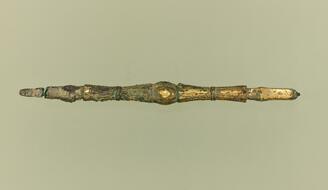
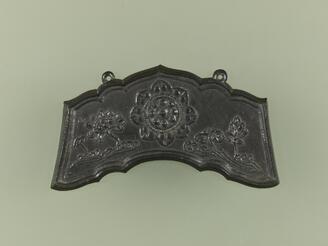
Shiketsu (Posts Erested at Four Corners of Alter to Rope off Sanctuary), Gilt bronze
独鈷
Metalwork · Heian, 12th centuryTNM
Home › Browse › Metalwork › Heian period › Basin for Bathing a Statue of the Infant Buddha
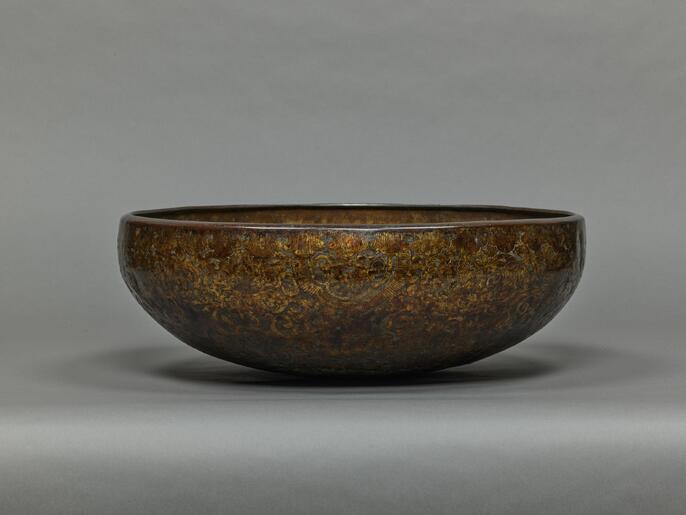
This is a large, shallow basin with a diameter of 46 centimeters. It was made by hammering out copper to form the shape, with repeated line patterns of flowers and vines engraved across the surface and the finished product coated with gold. The flowers may resemble peonies, but they are actually hosoge, imaginary flowers that frequently appear as decorative motifs in Buddhist art. From the large size, shape, and the Buddhist motifs, it is thought a small Buddhist statue was once placed in the center, with the basin then filled with water, tea, or other liquids. This statue probably represented the newly-born Sakyamuni. The infant Buddha would have stood steadily on two legs with his right arm pointing to the heavens and his left arm to the earth. The Kanbutsu was a ceremony that involved pouring holy water over a statue of the Buddha. It was performed on the eight day of the fourth month, the date of Sakyamuni’s birth, and it also became established in Japan with the transmission of Buddhism.
Todaji temple in Nara is famed for its colossal statue of the Buddha. It also houses a basin and infant Buddha statue that were produced for the Kanbutsu ceremony in the Nara period, during the 8th century. The ceremony is still carried out in temples across Japan on April 8 and people still pour scented tea over small Buddhist statues to commemorate Sakyamuni’s birth. This Kanbutsu basin has been hammered out very skillfully. It is very thin and surprisingly light. Japanese art in the 12th century was marked by an appreciation of gentle beauty. This aesthetic is on full display here in the rounded shape, inward-sloping rim, and refined hosoge flower pattern. The Buddha’s birthday is celebrated on April 8. During this celebration, worshippers pour a sweet herbal tea over a statue of the infant Buddha, which stands in a basin that collects the tea. The basin here features an extremely elegant incised pattern of vines with imaginary flowers called [hōsōge], a popular motif in Buddhist art.
— Museum description: Tokyo National Museum (CC BY 4.0), via ColBase / Japan Search.