National Treasure
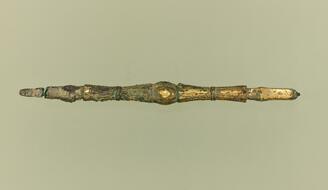
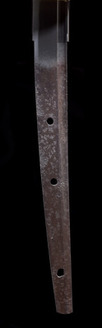
Shiketsu (Posts Erested at Four Corners of Alter to Rope off Sanctuary), Gilt bronze
独鈷
Metalwork · Heian, 12th centuryTNM
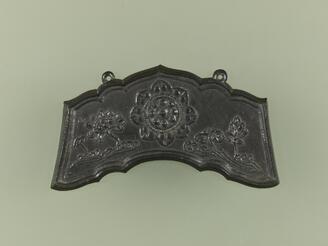
Home › Browse › Metalwork › Heian period › Tray for Ritual Tools ("Kongōban") with Lotus Vines
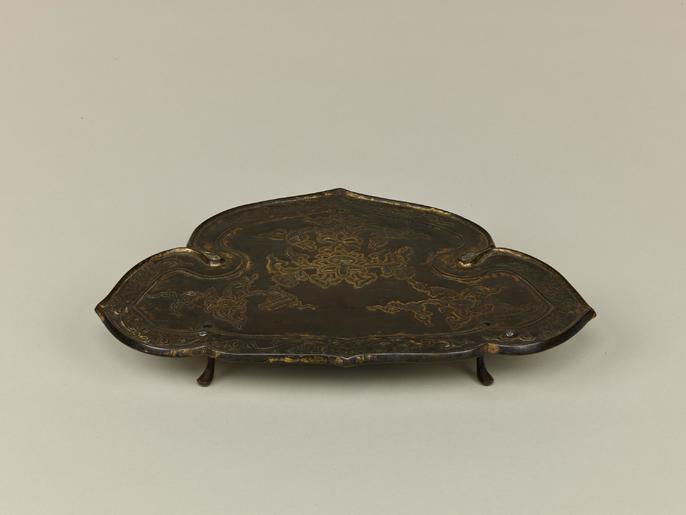
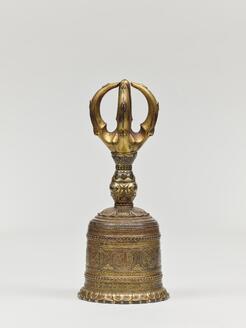
Esoteric Buddhism originated in ancient India and it then spread to China before arriving on Japan's shores at the start of the 9th century. The central figure in the Esoteric Buddhist pantheon is Dainichi Nyorai, or Mahavairocana in Sanskrit. He is surrounded by a variety of Buddhas with different roles. A diverse range of ritual implements are used in Esoteric Buddhism, though these can broadly be divided into two groups. One group contains practical vessels used to make offerings or hold liquids, flowers, or incense. The other group contains pointed weapon-like objects. These are said to be modelled on real weapons from ancient India. They are used to symbolize the striking down of worldly desires and wickedness. These ritual implements are arranged in a set order on the altar, with the priest then standing before the altar to perform the ceremony. A kongoban is a footed tray that holds weapon-like implements like vajras and vajra bells. It is shaped like a four-petalled flower. One petal hardly protrudes at all and is portrayed using essentially flat lines. Usually, the tray is set on the altar with this flat section at the front, with a five-pronged bell and a five-pronged vajra club in the center surrounded by a pestle with one prong, a pestle with three prongs, and a pestle with five prongs, all arranged in a triangle.
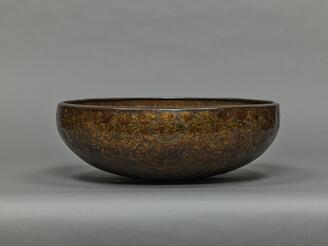
This kongoban was cast in bronze, with a lotus arabesque pattern engraved on the surface and the entire body covered with gilded bronze. It also has three legs fitted on the bottom. A slightly unusual carving method has been used for the lotus arabesque. Rather than engraving the shapes in lines, the producer has etched out the area around the patterns to produce a relief-like effect. Lotus arabesques carved in this fashion are characteristic of artworks from the 12th century. The technique lends the work a gentle, delicate air. Esoteric Buddhist implements would be placed on this legged tray. Shaped like a leaf, it features two droplet-shaped openings on either side, adding decorativeness. Gentle designs, as seen on this tray, are a typical characteristic of trays of this type from the late Heian period (794–1192).
— Museum description: Tokyo National Museum (CC BY 4.0), via ColBase / Japan Search.