Important Cultural Property
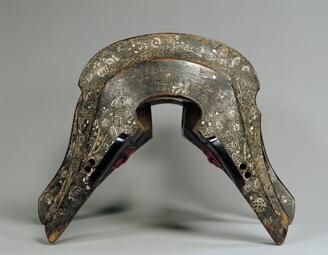
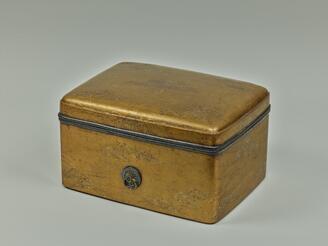
Sutra box depicting peacocks in gold inlay
孔雀鎗金経箱
Lacquerware · Kamakura, 1315Kyushu NM
Home › Browse › Lacquerware › Nanbokuchō period › Box with Chrysanthemum Flower Design in Makie

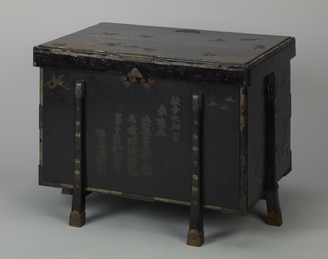
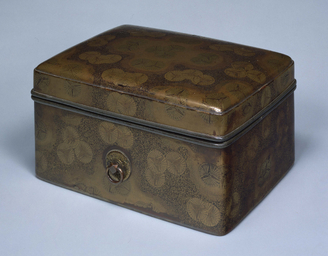
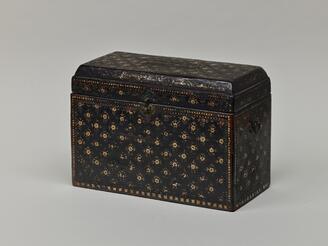
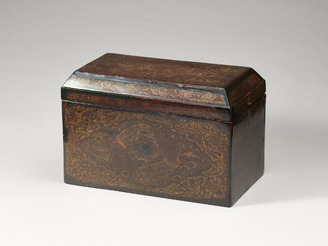
In ancient times, chrysanthemums were believed to hold the power of perennial youth and long life. Accordingly, it was a custom to sip kikkashu (sake with chrysanthemum petals) outdoors around September 9 to repel tragedies and disasters. Chrysanthemums have often been depicted on lacquer wares as an auspicious symbol representing longevity. Some were created based on legends and literary works related to the flower such as the Kiku-magaki (chrysanthemum fence) and Kiku-jidō (chrysanthemum boy). This is a rectangular box with a beveled cover. These are rims on where the box border and cover meet. The cover has a gently-curved dome-shaped top with chirii (a narrow flat border), and the bottom has slightly-carved corners. Filed and pressed coarse flakes of gold and silver are sprinkled over the black lacquer surface. On both the cover and the sides of the box, chrysanthemum branches growing from the earthen mounds are depicted using the usuniku taka-maki-e technique (patterns are slightly raised with lacquer and then gold and silver powder is sprinkled atop). Parts of the chrysanthemums are made by gold, silver, and mother-of-pearl inlay. Petals are depicted with narrow lines of e-urushi.
The cores of the flowers are decorated with thin sheets of silver. The chrysanthemums have double petals and vary in form, such as a full-faced flower, the back of a flower, a flower facing sideways, and a bud. To depict the earthen mounds, the usuniku taka-maki-e and togidashi maki-e (black lacquer coated over a metal decoration) techniques are used. Bamboo grasses and ferns are also added around the chrysanthemums. The metal fittings on both sides have chrysanthemum design resembling the kuyomon (crest of nine circles). This is consistent with the design on the box surface. Among the lacquer boxes produced from the Nambokuchō period (1336–92) to the Muromachi period (1338–1572), only a few have chrysanthemum designs. They include the “Box of kiku-magaki maki-e” (National Treasure, collection of Kumano Hayatama shrine, Nambokucho period, 14th century) and the “Box of kiku-jido maki-e” (Important Cultural Property, a collection of Sōji-ji temple, Muromachi period, 15th century). As one such rare examples from the Nambokuchō to Muromachi period, this box was designated an Important Cultural Property in 2009.
— Museum description: Kyushu National Museum (CC BY 4.0), via ColBase / Japan Search.