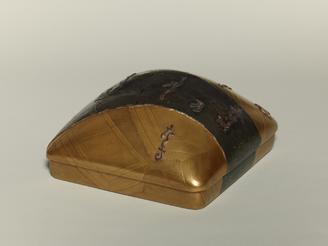
National Treasure

Box for Personal Items with a Design of Carriage Wheels in Water
片輪車蒔絵螺鈿手箱
Lacquerware · Heian, 12th centuryTNM
Home › Browse › Lacquerware › Kamakura period › Box for Personal Items with a Design of Carriage Wheels in Water

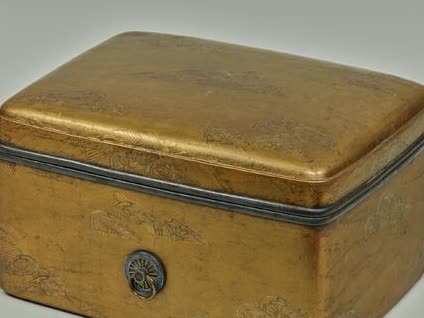
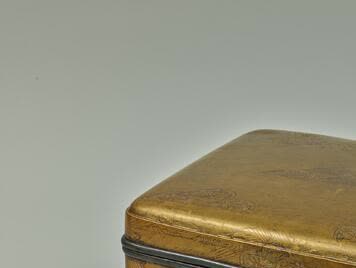
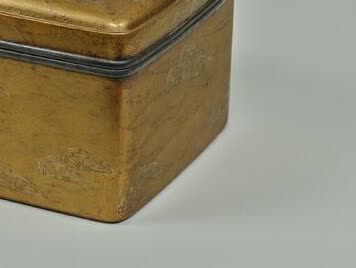
Tebako are boxes used to store small personal belongings such as cosmetics and stationary. This tebako features several ox-cart wheels scattered throughout a flowing water pattern that covers the entire outer surface. This pattern of ox-cart wheels half-submerged in flowing water is known as the “wheels-in-stream” design. It derives from the practice of dipping wooden cart wheels in water to prevent them from drying out and cracking when not in use. Familiar scenes like this were often incorporated into paintings and decorative objects in Japan. Ox carts were used by the nobility and were thus associated with the elegant courtly culture that flourished in Japan from the 11th to the 12th century, with ox carts commonly used as traditional motifs by later generations. The two silver cord holders attached to the sides are also shaped like cart wheels.
The box is made of wood, with the gold ground and flowing water rendered in maki-e, a technique that involves sprinkling gold powder onto lacquer. The wheels-in-stream design also uses a technique in which flattened pieces of mother-of-pearl are delicately inlaid into the surface. The lacquered surface of this box is also covered by a dense sprinkling of gold powder and then polished to emphasize the intensity of the gold color. The tall shape and the metallic gold maki-e imbue the box a powerful solidity. The mother-of-pearl ox-cart wheels are also arranged in a systematic way. The stately, refined techniques and designs aptly demonstrate the characteristic features of lacquerware objects from the 13th century, the Kamakura period.
— Museum description: Tokyo National Museum (CC BY 4.0), via ColBase / Japan Search.