National Treasure
Writing Box with a Pontoon Bridge
舟橋蒔絵硯箱
Lacquerware · Edo, 17th centuryTNM
Home › Browse › Lacquerware › Edo period › Writing Box with the Yatsuhashi Bridge

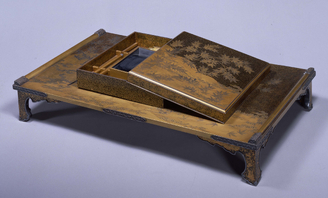
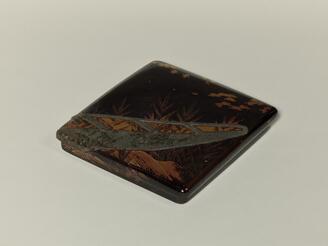
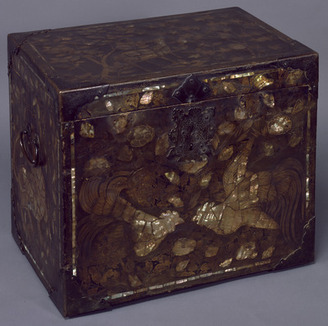
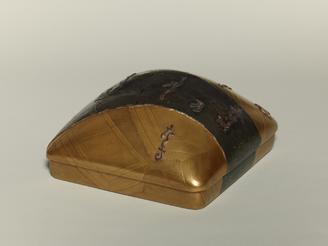
The upper tier of this writing box holds an inkstone and a water dropper, while the lower tier is used for storing paper. An uneven bridge made of wooden planks zig-zags across the box's surface. Groups of blooming irises also adorn each side. These are differentiated by positioning and the number of flowers. These motifs cover the entire outer surface, apart from the base. The design seems quite bold, yet also carefully planned. Flattened pieces of mother-of-pearl are used for the iris blossoms, while the leaves and stalks were drawn in lacquer, with gold powder sprinkled on top before the lacquer dried. The design seems quite audacious, but it is actually the product of traditional lacquerware techniques. The plank-bridge and irises represent Yatsuhashi, or the “Eight-plank Bridge,” a location in eastern Aichi prefecture that is famously referenced in The Tales of Ise, a classic of Heian-period literature.
The artist Ogata Korin was active from the end of the 17th century to the start of the 18th century. As epitomized by this writing box and his famous painting depicting the Eight-plank Bridge, Korin took traditional motifs from classical literature and reframed them through the prism of his own refined sensibilities. This box held paper and writing utensils. Its surface depicts the Eight-Plank Bridge, a celebrated motif in Japanese literature. The wooden planks are rendered in lead, while the water below is suggested in black lacquer. The irises are depicted in gold and mother-of-pearl. This bold, minimalistic design was revolutionary for its time.
— Museum description: Tokyo National Museum (CC BY 4.0), via ColBase / Japan Search.