National Treasure
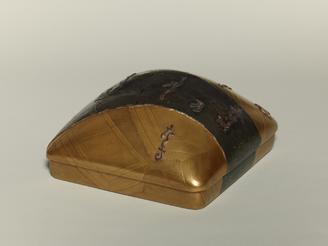
Writing Box with a Pontoon Bridge
舟橋蒔絵硯箱
Lacquerware · Edo, 17th centuryTNM
Home › Browse › Lacquerware › Edo period › Display Stand and Writing Box with Scenes from The Tales of Ise

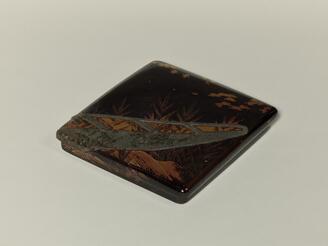
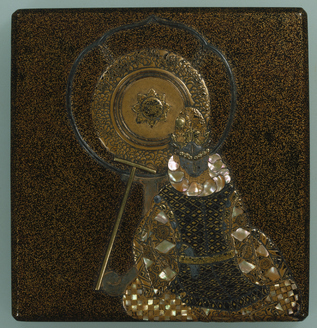
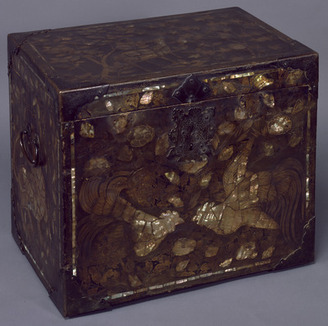
This set is comprised of a low table and a matching writing box for holding inkstones, brushes, and other writing materials. Both are made entirely of wood coated in black lacquer and decorated in gold and silver powders. The mountains and hills are depicted using densely sprinkled powder, while the ivy and maple leaves are rendered on a raised surface built up with layers of lacquer and coated in gold powder. A monk’s wooden backpack along with birds are rendered in larger pieces of silver. The decorative metal fittings on the table are also made of silver and engraved in intricate designs. The sophisticated techniques for applying gold and silver along with the impressive metal fittings are hallmarks of the era in which the set was made. On the underside of the table and underneath the inkstone, the name “Tatsuke Chōbei” is written in gold powder. Chōbei was a skilled lacquerware artist who was active in the latter half of the 17th century. The top of the table and the back of the writing box’s lid are decorated with the image of a monk’s wooden backpack left out amid an autumn scene of ivy and maple trees. Wooden packs of this type were carried by practitioners of a type of mountain asceticism called Shugendō, who worshipped Shinto or Buddhist deities in the mountains. The axe depicted beside the pack also belongs to a mountain ascetic.
On top of the wooden backpack is a letter tied at both ends. What do these motifs mean? They are thought to symbolize a scene from The Tales of Ise, a classic work of literature whose hero is the 9th-century nobleman Ariwara no Narihira. The amorous Ariwara no Narihira traverses a pass across Mount Utsu in Shizuoka Prefecture on a journey east from Kyoto. The road through the pass is famously described as “a narrow path overgrown with ivy.” Narihira passes a monk on this road and asks him to deliver a poem he has written to a woman he has left behind in Kyoto. The birds on the interior of the writing box are presumably meant to be oystercatchers, with which Ariwara no Narihira is strongly associated. Literary classics like The Tales of Ise remained familiar to people of later eras and their stories continued to be referenced in paintings and the decorative arts. This set alludes to a literary scene using symbolic motifs alone, without depicting a single human figure. These items were used in poetry contests, a favorite pastime of the nobility and samurai. The box was used for holding writing tools, while the table was used for displaying poems. The tabletop depicts an episode from [The Tales of Ise], a 10th-century work of literature that contains some of Japan’s most celebrated poetry.
— Museum description: Tokyo National Museum (CC BY 4.0), via ColBase / Japan Search.