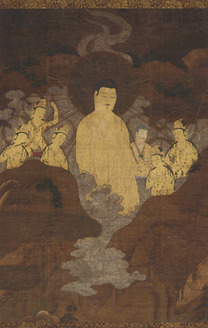
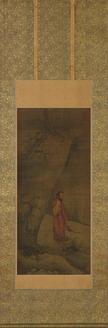
National Treasure

Bishamon Ten (Vaiśravaṇa), Extermination of Evil (J., Hekija-e)
辟邪絵 毘沙門天像
Paintings · Heian, 12th centuryNara NM
Home › Browse › Paintings › Kamakura period › Twelve Heavenly Deities (Devas)

A group of twelve Buddhist deities consists of eight deities who guard eight directions (Taishaku-ten or Indra for the east, Ka-ten or Agni for the south-east, and Emma-ten or Yama for the south, Rasetsu-ten or Rakṣasa for the south-west, Sui-ten or Varuṇa for the west, Fū-ten or Vāyu for the north-west and Bishamon-ten or Vaiśravaṇa for the north and Ishana-ten or Īsāna for the north-east), and two deities who guard the sky and the ground (Bonten or Brahmā for the sky and Ji-ten or Pṛthivi for the ground), and two more deities who are in charge of the movement of the sun and the moon (Nitten or Ādiya or Sūrya for the sun and Gatten or Candra for the moon). These twelve deities have been worshipped as guardian deities of esoteric Buddhism. The twelve deities have been depicted in two iconographical styles: either in standing posture or in sitting posture.
The figures introduced in this article are either standing on a lotus-leaf seat, or on a rug seat, or on a moving cloud. Holy letters representing deities are written in ink on disks at the top of the paintings. This style of composition is called the folding screen style which is also found in other paintings of the twelve deities such as the one in Tō-ji temple (National Treasure) and in Jingo-ji temple (Important Cultural Property). It is said that folding screens of the twelve deities used to be painted for the purpose of substituting those deities for the parade at the Kanjō ritual of esoteric Buddhism. Judging from the precise brush strokes of the outlines, it is conceivable that these scrolls were painted by some Buddhist painter in the mid-Kamakura period.
— Museum description: Nara National Museum (CC BY 4.0), via ColBase / Japan Search.