National Treasure

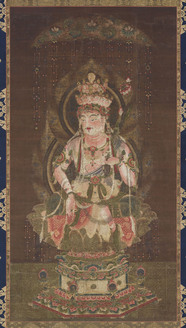
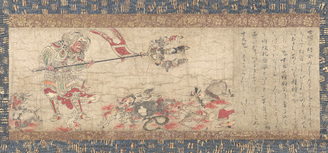
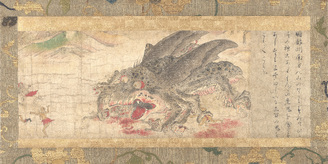
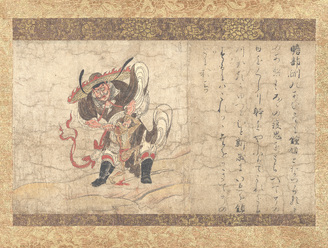
Bishamon Ten (Vaiśravaṇa), Extermination of Evil (J., Hekija-e)
辟邪絵 毘沙門天像
Paintings · Heian, 12th centuryNara NM
Home › Browse › Paintings › Muromachi period › Hue of the Water, Light on the Peaks

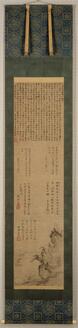
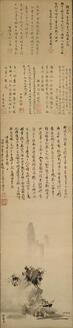
{i=>[shigajiku], content=>[This painting is a masterwork of , —hanging scrolls combining a painting with poetic inscriptions offered by several people responding to it, a format that became prevalent in Zen circles. At the top, three Zen priests have written poems on the painting’s theme. Its theme of an ideal scholarly retreat in the mountains was immensely popular at Zen temples as well. This painting is often attributed to Shūbun (active until 1454), who served the Muromachi shogun’s family as an official painter.]} {br=>[[], []], content=>[This is a representative example of a type of ink painting known as shosaizu (\images of a scholarly retreat\), a subject popular among Zen priests in the early Muromachi period (1392-1573). The first of the three poems inscribed at the top of the painting begins with the four characters suishoku rankō, a phrase that can be literally translated as \hue of the water, light on the peaks,\ which has been taken as the title of the painting. The work depicts a small, simple hut set in the quiet of nature, far from the bustle of urban life. Here, one can enjoy the literati's ideal of absorbing oneself in study. In reality, however, the Zen priest of the period lived in temples in the middle of the city. When a priest built a studio in his urban temple, to celebrate the new building, he painted an image inspired by the name of his new retreat, which removed him from mundane reality. Above this painting, his fellow priests brushed poems referring to this idyllic place. Such hanging scrolls combining painting and poetry in this manner are called shigajiku—literally, \poem-painting scrolls.\ While shigajiku were created primarily during the Ōei (1394-1428) and Eikyō (1429-41) eras, the date on the last poem inscribed here indicates that it was done slightly later—around 1445 (Bun'an 2), this work can be seen as a consummation of this form., The significance of this dynamic piece cannot be overlooked in examining the general development of landscape painting.
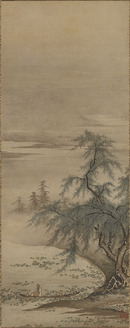
A representative ink painting of the same genre from the ealier Ōei period is the painting in Konchi-in Temple entitled Cottage by a Mountain Stream (J. Kei'in shōchikuzu), thought to date from 1413 (Ōei 20). In this work, the literati's studio—in the center of the painting—occupies most of the spatial composition, while the foreground and distant background appear flat, lacking a sense of depth. In contrast, Shūbun moved away from the simple portrayal of a solitary scholarly retreat to create a rich, expansive landscape. Three pine trees act as the central motif in the foreground, while the study is nestled in the shadow of a rocky ledge. The shore spreads out in the middle ground as the mountain peaks rise above in the distance., At the same time, however, the arrangement of various elements in this work lacks concision and a sense of three-dimensional space in its execution, such achievements in composition and style had to wait another generation of painters until the appearance of Sesshū (1420-1506). However, the absence of structural clarity may be best explained as the inevitable result of an attempt to express a retreat away from reality that characterizes paintings of scholarly hermitages. In this sense, this painting is an excellent example of the art produced within the cultural sphere of Zen Buddhism, which shunned the worldly realm.]}
— Museum description: Nara National Museum (CC BY 4.0), via ColBase / Japan Search.