National Treasure

Bishamon Ten (Vaiśravaṇa), Extermination of Evil (J., Hekija-e)
辟邪絵 毘沙門天像
Paintings · Heian, 12th centuryNara NM
Home › Browse › Paintings › Heian period › Thousand-Armed Kannon (Sahasrabhūja)
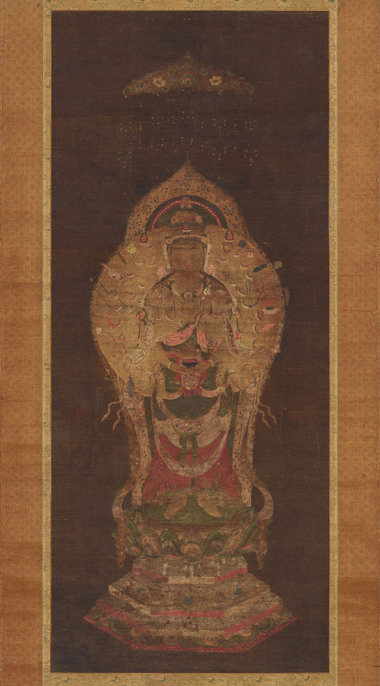
There is a statue of the bodhisattva Avalokiteśvara that joined the museum’s collection from Kōfukuji Temple, and this painting was folded up and interred within it. The painting is a magnificent image of Senju Kannon (Skt. Sahasrabhuja-āvalokiteśvara). There are many elements to this work that exemplify the perfections of later Heian-period Buddhist painting: its composed and tranquil expression, the details of its form outlined in red with a precise but free hand, and the addition of silver foil to embellish the floral and arabesque designs of its mandorla. This statue is well-known as one of the rarest examples of wooden statues in which an independent Buddhist painting was contained. Although several parts are damaged and missing, this statue is recognized as Jūichimen Senju-kannon (Sahasra-bhuja) and the date of production is considered to be the late Heian period.
The painting may have been made slightly earlier than that. Although the size is small, the painting shows a dignified Buddhist figure with a decorated canopy and a seat. The contrast of red and green is a key-note of the coloring, and various colors and gold and silver foils are finely arranged. Depiction is not accurate, and a gentle air can be sensed in this picture. The arms, which are arranged as if they were part of the halo, modify the unfamiliar appearance of the figure. Among Kannon's belongings, most the weapons are omitted probably by intention, and the bowl is represented as a lacquered bowl. These aspects indicate that some court noble worshipped it privately.
— Museum description: Nara National Museum (CC BY 4.0), via ColBase / Japan Search.


