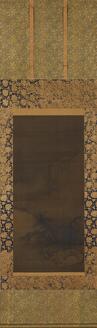
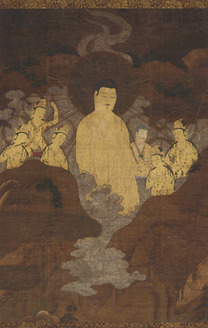
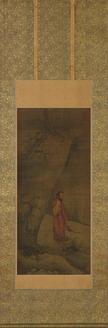
National Treasure

Bishamon Ten (Vaiśravaṇa), Extermination of Evil (J., Hekija-e)
辟邪絵 毘沙門天像
Paintings · Heian, 12th centuryNara NM
Home › Browse › Paintings › Kamakura period › The White Path Between Two Rivers
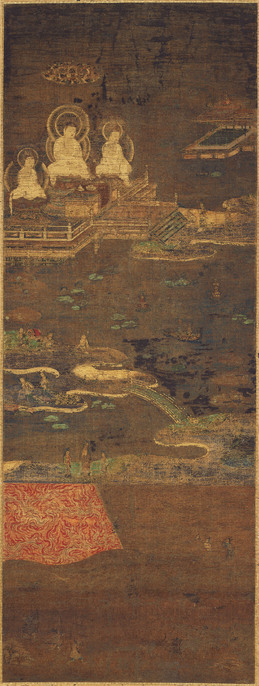
The Chinese priest Shandao (J. Zendō; 613–681) preached using the metaphor that this painting illustrates: faith in Amida (Skt. Amitābha) is the white path that leads one directly to the Pure Land paradise, the Land of Heavenly Bliss (Gokuraku Jōdo). Even if one is stranded between the river of fire, symbolizing anger and hatred, and the river of water, which symbolizes attachment, one can take this path of Amida faith and arrive at the Pure Land. {br=>[[]], content=>[The motif of the white path to Amida's (Amitābha's) Pure Land between the two rivers was derived from the parable in the fourth volume of the Kanmuryōju-kyō-sho (an annotated edition of the Kanmuryōju-kyō sutra) written by Priest Zendō (613-681), a Chinese Jōdo Buddhist of the Tang dynasty. In Japan, Priest Hōnen (1133 - 1212) quoted this parable in his Senchaku Hongan Nenbutsu-shū, and Priest Shinran (1173 - 1262) mentioned the same parable in the Kyōgyō Shinsho. Since then, the white path between two rivers has become a painting motif in several schools of Jōdo Buddhism.
One of the two rivers is the river of fire which symbolizes anger and hatred, and the other one is the river of water, which symbolizes persistence and avarice. By believing in Amida and by overcoming the worldly temptations which were symbolized by the rivers, one could walk along the white path leading to Amida's Pure Land., In Japan, the motif of the white path between the two rivers was based on the description in the Kanmuryōju-kyō-sho, and usually many other objects were added to the scene. In the painting introduced in this article, Amida's Pure Land is described at the top left of the scene, where some human figures are depicted in the sacred pond. At the western end of the white path, Amida and his attendants (Amitābha Triad) are waiting. This world is depicted at the bottom of the painting. The detailed description with finely cut gold foil is notable.]}
— Museum description: Nara National Museum (CC BY 4.0), via ColBase / Japan Search.