National Treasure
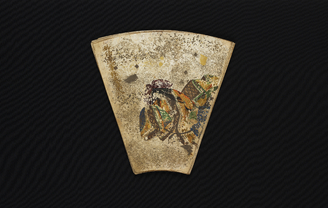
Bound Fan Papers with the Lotus Sutra
扇面法華経冊子
Paintings · Heian, 12th centuryTNM
Home › Browse › Paintings › Heian period › The Iconography of the Buddhist Patriarchs
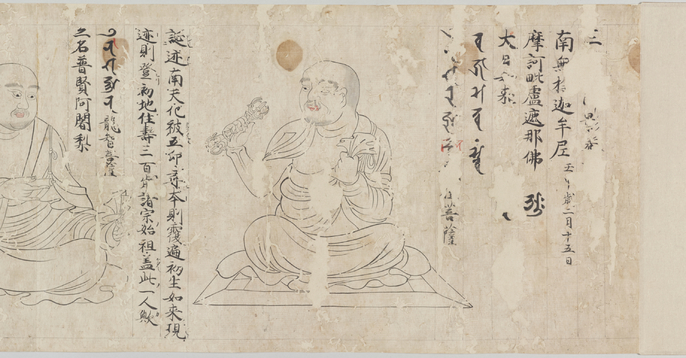
This is a painting of 46 Buddhist patriarchs from India, China and Japan. In the 12th century, as the Heian period (794–1192) came to an end, there was a growing interest both in Buddhism and in the people who spread its teachings. The paintings on this handscroll depict people who furthered the cause of Buddhism in India, China, and Japan. There are forty-six in total. In addition to their likenesses, the handscroll contains information about them such as their names, personal descriptions, and dates of death. They appear to be organized by the school of Buddhism they belonged to rather than by time period. As a result, certain figures are presented side-by-side, such as the Indian monk Bodhidarma, who founded what came to be known as the Zen school around the 6th century, Prince Shōtoku, who spread Buddhism in Japan in the 7th century, and the monk Kūkai, who founded the Shingon school in the 9th century. Ink-line paintings such as these were painted as rough drafts or blueprints for Buddhist paintings. Because every detail of each figure’s expression and posture is clearly visible, these paintings were also used as reference materials for creating other paintings. If you look closely, however, you will see that the figures’ hair and beards are painted in diluted ink and their lips are tinged with red.
It is thought that these paintings were partially colored in order to show them to high-ranking people in addition to those within the painter’s social circle, or to prepare the handscroll to be passed on to future generations. The postscript at the end of this handscroll tells us that a Buddhist monk named Genshō (1146–1222) copied it from a book that belonged to his teacher, the monk Ninsai. Genshō is known for collecting and compiling a large number of ink-line paintings of this type. This handscroll, however, is a valuable example of Genshō’s own work, few of which survive today. The figures are depicted using smooth, carefree lines, and the lineweight reveals the movements of Genshō’s hand, such as where he put down or lifted his brush. Each figure’s expressions and postures are distinctly unique and skillfully capture each individual’s characteristics as they were understood at that time. Numerous paintings must also have been created based on these ink-line paintings. It could be interesting to look for what has and has not changed about the way we picture these people today.
— Museum description: Tokyo National Museum (CC BY 4.0), via ColBase / Japan Search.