National Treasure

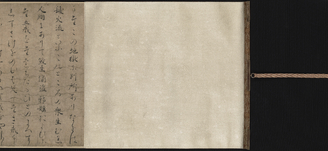
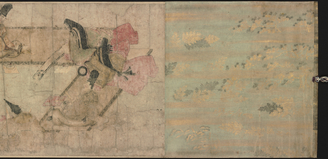
Bound Fan Papers with the Lotus Sutra
扇面法華経冊子
Paintings · Heian, 12th centuryTNM
Home › Browse › Paintings › Heian period › The Bodhisattva Fugen

The bodhisattva Fugen is depicted riding on a white elephant with his legs crossed in front of him. Fugen is believed to appear before and protect people who believe in the Lotus Sutra, a sacred collection of Buddhist teachings. The Lotus Sutra had a strong following of believers during the Heian period (794–1192), which lasted from the 8th until the 12th century. The bodhisattva Fugen is riding on a white elephant under a gentle shower of flower petals. Fugen’s smooth, pale skin is faintly tinged with red, and his gaze is focused slightly below and ahead of himself. The elephant is walking from the right side of the image, which represents the east, and is turning to look back the way it has come. An umbrella made of flowers floats overhead. This is a painting of a single, dreamlike moment in time. Look closely at the painting.
Details such as Fugen’s garment, the halo behind him, and the elephant’s saddle are decorated in intricate designs made up of fine, threadlike strands of gold leaf. Buddhist paintings from this period usually feature bodies painted in red lines. In this painting, however, the bodhisattva’s body is painted in faint lines of diluted black ink, a choice likely made to avoid undercutting the whiteness of Fugen’s skin. The intensities of the individual lines are varied despite being thin, the hem of Fugen’s garment realistically follows the contours of his pedestal where it hangs over the edge, and the colors, such as green and red, are bright and clear. All of these points are atypical of Japanese Buddhist art of this time and suggest influence from Chinese paintings of the same period.
— Museum description: Tokyo National Museum (CC BY 4.0), via ColBase / Japan Search.