National Treasure

Bound Fan Papers with the Lotus Sutra
扇面法華経冊子
Paintings · Heian, 12th centuryTNM
Home › Browse › Paintings › Heian period › The Buddha Entering Nirvana
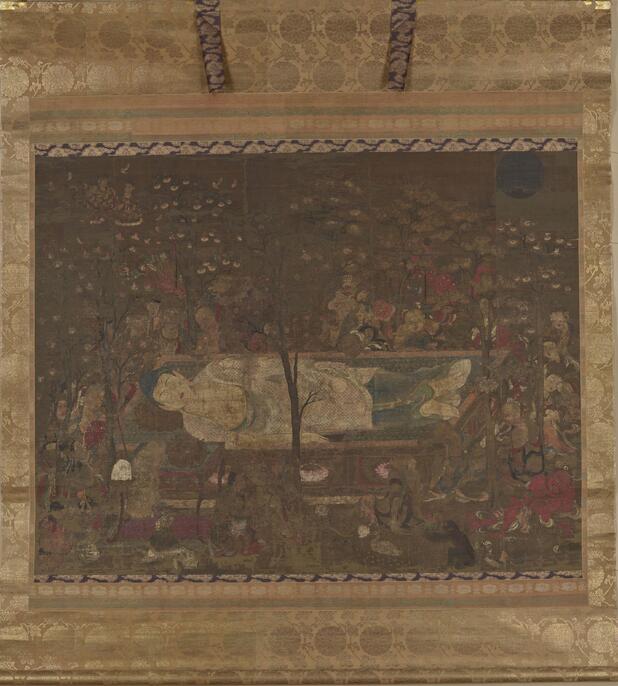
The Buddha lies dying, about to pass into the ultimate state of spiritual enlightenment. Monks hung up this painting for annual ceremonies commemorating the Buddha's death. This painting depicts Sakyamuni, the founder of Buddhism, dying beneath sal trees and entering Nirvana. Nirvana originally denoted a state freed from troubles and worries, but the term is also used to indicate the death of the historical Buddha. Nirvana paintings like this one are displayed on February 15, the date of Sakyamuni‘s death, at Buddhist ceremonies held to honor and praise his memory. Nirvana paintings from the Heian period are characterized by horizontally-long screens and a closer focus on Sakyamuni. This composition engenders a feeling of closeness, almost as if the viewer has stepped inside the scene.
Sakyamuni wears a serene expression as he lies in the center. His clothing features an intricate pattern. This was rendered by hammering gold and silver into thin sheets, with the sheets then cut into thin strips and pasted onto the painting‘s surface. The silver foil has tarnished to black over time, but the gold and silver must have shone brilliantly when the painting was first made. The garment covering Sakyamuni‘s lower body is also drawn with great skill, with color gradations and highlights used to create a graceful impression. Sakyamuni is surrounded by bodhisattvas and pupils. The humanity of the mourners is in full display in their sad countenances. Their expressions contrast markedly with those of Sakyamuni.
— Museum description: Tokyo National Museum (CC BY 4.0), via ColBase / Japan Search.