National Treasure

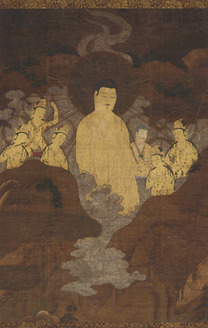
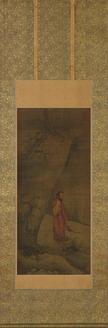
Bishamon Ten (Vaiśravaṇa), Extermination of Evil (J., Hekija-e)
辟邪絵 毘沙門天像
Paintings · Heian, 12th centuryNara NM
Home › Browse › Paintings › Kamakura period › Mandala of the Two Realms (J. Ryōkai Mandara) in a Shrine
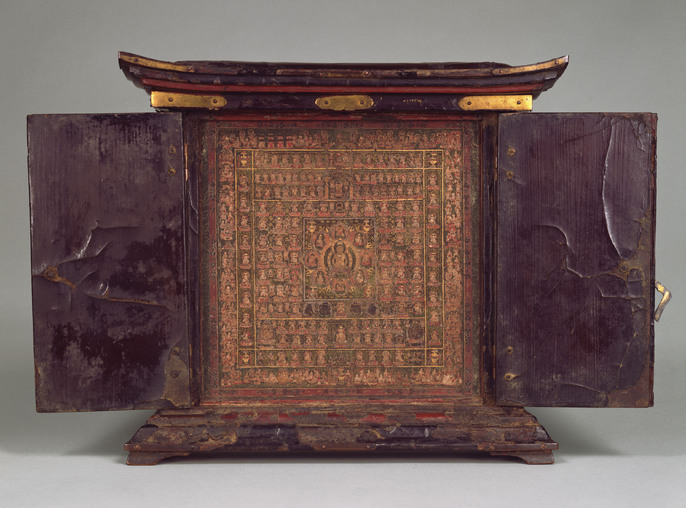
{i=>[mikkyō, kirikane], content=>[The realms of esoteric Buddhism (, ) are illuminated in the mandalas of the Diamond World (Skt. Vajradhātu; J. Kongōkai) and the Womb World (Skt. Garbhadhātu; J. Taizōkai). Here, the mandalas are painted on bast fiber and then mounted back to back, enshrined as a pair. Their deities are rendered with tranquil expressions in exquisite detail embellished with elegant decoration of cut gold leaf (, ).]} {br=>[[]], content=>[ Two panels of mandala paintings are placed within a miniature shrine of graceful shape. The two panels were inserted from the top of the shrine by removing the roof. Doors are attached both to the front and back sides so that the mandala paintings can be seen from both sides., Both panels, which are made of hinoki wood (Japanese cypress), are covered with silk and coated with white wash. Mandala pictures were painted over the white washed surface of the panels. The extremely detailed and precise paintings on these small screens are notable.
The composition of these mandalas is based on the mandala painting which was brought to Japan from China by Priest Kūkai. In the Taizō-kai (Garbhadhātu or womb) Mandala, dividing lines, halos, and drapes of the principle image were represented with cut-gold foil and the background is decorated with fine and complicated designs in cut-gold foil. In the Kongō-kai (Vajradātu or diamond) Mandala, excellent decorative effects can be observed, such as a network pattern in cut-gold foil on the outside of the Shi-in square section at the top left corner. Child-like faces of the Buddhist figures, bright pigment which indicates good quality of this painting, fine decoration with cut-gold foil and beautiful coloring reflect the artistic taste of the late Heian period. The date of production might be no later than the early Kamakura period. The black lacquered miniature shrine was made during the same period, and it, too, reflects the air of the late Heian period.]}
— Museum description: Nara National Museum (CC BY 4.0), via ColBase / Japan Search.