National Treasure

Bishamon Ten (Vaiśravaṇa), Extermination of Evil (J., Hekija-e)
辟邪絵 毘沙門天像
Paintings · Heian, 12th centuryNara NM
Home › Browse › Paintings › Heian period › Iconographic Drawings of Manifestations of Kannon (Avalokiteśvara)
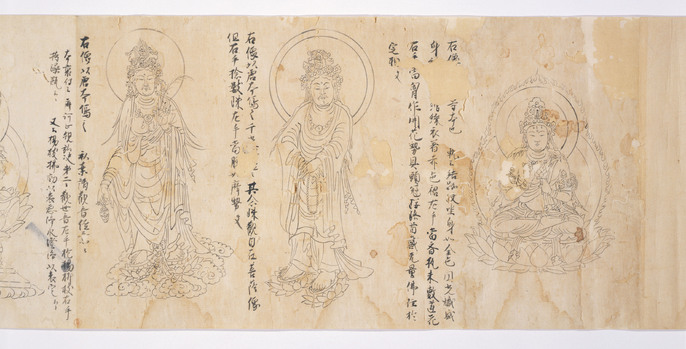
This is a compilation of six forms of Kannon (Sk. Avalokiteśvara), which includes Shō Kannon, Senju Kannon, Batō Kannon, Fukū kensaku Kannon, Byaku-e Kannon, and Nyoirin Kannon. The colophon states that this work was created by the monk Jōshin (d. 1119) of Kiyomizudera Temple in 1078 (Jōryaku 2), but this scroll itself seems to have been copied during the late Heian period (794-1185). {i=>[Lotus Sutra, Saddharmapuṇḍarīka-sūtra, Fahua jing, Hoke kyō], content=>[The bodhisattva Kannon (Skt. Avalokiteśvara) appears in myriad forms to rescue those in need, as expounded in the , (Skt. , ; Ch. , ; J. , ). There are also several emanations of this powerful and compassionate deity, six of whom are portrayed in this compilation of iconographic drawings: Shō-Kannon, Senju Kannon, Batō Kannon, Fukūkensaku Kannon, Byakue Kannon, and Nyoirin Kannon. A priest by the name of Jōshin (dates unknown) who later became the abbot of Kiyomizudera Temple left an inscription at the end of the scroll in 1078 (Jōryaku 2), revealing this to be a slightly later copy of his work.]} Iconographic line drawings for six emanations of the bodhisattva Kannon (Skt. Avalokiteśvara) are contained in this scroll. The colophon says the drawings were copied in the 6th month of Jōryaku 2 (1078) by Jōshin (dates unknown), who later became the abbot of Kiyomizudera Temple. Despite this, a note on the back of the end of the scroll has the misprint Ōhō 2 (1162) instead of Ōtoku 2 (1085), suggesting this handscroll is a later copy of Jōshin’s drawings (copied in 1078) that was made at the end of the Heian period (794–1185).
The work was likely meant to depict the six emanations of Kannon, as they are drawn in the following order: Kannon (untransformed), Thousand-Armed Kannon (J. Senju Kannon; Skt. Sahasrabhuja-avalokiteśvara), Horse-Headed Kannon (J. Batō Kannon; Skt. Hayagrīva), Kannon of the Unfailing Lasso (J. Fukūkensaku Kannon; Skt. Amoghapāśa), White-Robed Kannon (J. Byakue Kannon; Ch. Baiyi Guanyin), and Nyoirin Kannon (Skt. Cintāmaṇicakra). Nonetheless, the work appears to have been produced in the context of Jōshin’s faith in Nyoirin Kannon specifically, as he added an original interpretation at the end explaining how Nyoirin Kannon’s six arms correspond to the six realms of rebirth and the six emanations of Kannon. The work also contains an iconographic drawing that appears to be a copy of a two-armed Nyoirin Kannon that had attracted a devoted following as the principal image of worship at Ishiyamadera Temple. The two-armed Nyoirin Kannon that was enshrined at Ishiyamadera Temple at its founding burned down in the 1st month of Jōryaku 2 (1078). Jōshin produced this handscroll a mere six months later, suggesting he may have been motivated by the incident.
— Museum description: Nara National Museum (CC BY 4.0), via ColBase / Japan Search.


