National Treasure

Bishamon Ten (Vaiśravaṇa), Extermination of Evil (J., Hekija-e)
辟邪絵 毘沙門天像
Paintings · Heian, 12th centuryNara NM
Home › Browse › Paintings › Heian period › Iconographic Drawings: Deities of the Womb World Mandara
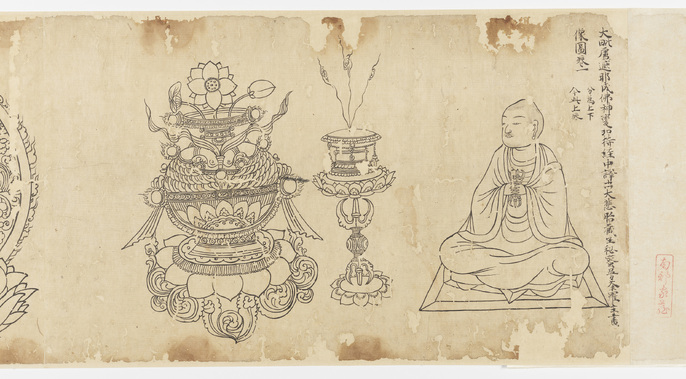
The Tendai priest Enchin (814–891) is one of the major eight figures whose transmission of texts and material culture from China forever changed Japanese Buddhism. He returned from his journey to the Tang dynasty (618–907) with new teachings and objects that would hasten and enrich the development of Tendai’s esoteric traditions. Here, iconographic drawings that copy those he brought back illustrate with precision the deities of the esoteric Buddhist pantheon appearing in a mandala of the Womb World (Skt. Garbhadhātu; J. Taizōkai). They are distinctive in part for the Indian mode in which many of the figures are portrayed. The Buddhist figures in this Taizō-kai (Garbhadhātu or womb) Mandala are depicted in lines drawn in ink. The first volume contains the Buddhist figures from the Chūdai Hachiyō-in central section, Jimyō-in section, Kannon (Avalokiteśvara) group, Monju (Mañjuśrī) group, Jogaishō group, Jizō group and Kokuzō group. The second volume covers the Buddhist figures from Shaka (Śākyamuni) group, and the outer Kongō (Vajra or diamond) group. In both of the scrolls icons were arranged in two lines, and a portrait of Priest Zenmui (Śubhakarasiṃha) of esoteric Buddhism is painted at the last part of the scroll.
According to the inscription placed next to this portrait, the iconographies in these scrolls were based on the text of the Dainichi-kyō (Maha-vairocanabhisaṃbodhi-vikurvitadhiṣṭhāna-vaipulya-sutrendra-raja-nāma-dharmaparyana sūtra) which was translated by Priest Zenmui into Chinese at Luoyang in China. The scrolls introduced in this article are the third copy made in 1194. The first copy was made during the Eikyū era (1113―1118), and the second one was made during the Jishō era (1177―1181). Although they are copies, the Buddhist figures are depicted in a way as if the muscles of their bodies contained springs—which shows the influence from India and the western districts in China; the iconographies reflect the style of the original version well. It is known that the original version, which consisted of one handscroll, was acquired by Priest Enchin who divided it into two scrolls and brought to Japan.
— Museum description: Nara National Museum (CC BY 4.0), via ColBase / Japan Search.


