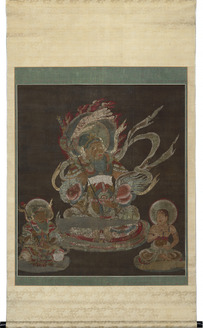
National Treasure

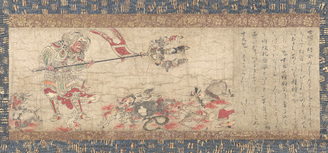
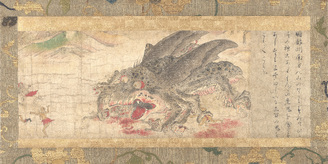
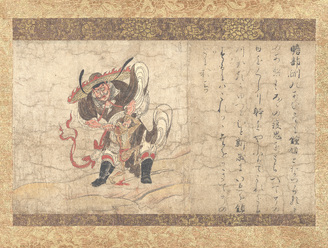
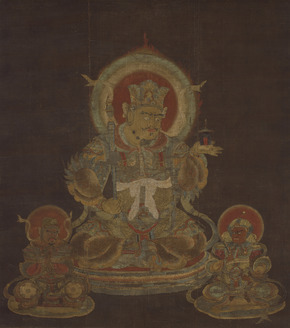
Bishamon Ten (Vaiśravaṇa), Extermination of Evil (J., Hekija-e)
辟邪絵 毘沙門天像
Paintings · Heian, 12th centuryNara NM
Home › Browse › Paintings › Heian period › Fugen (Samantabhadra)
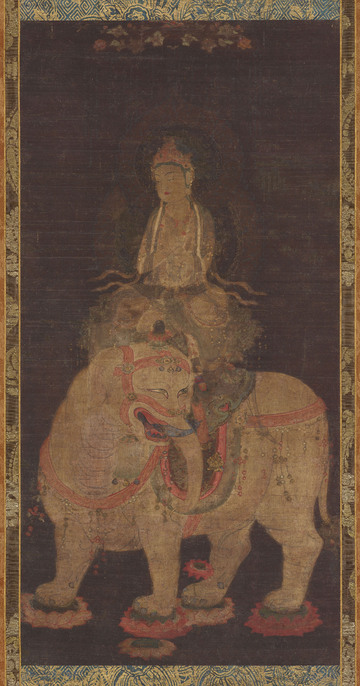
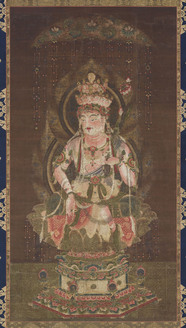
{i=>[Lotus Sutra, Saddharmapuṇḍarīka-sūtra, Fahua jing, Hoke kyō], content=>[This painting depicts the bodhisattva Fugen (Skt. Samantabhadra) with both hands pressed together in reverence, riding on the back of a white elephant; the figure is truly beautiful, with a charming face and sloping shoulders on a thin frame. Together with the rise of belief in the , (Skt. , ; Ch. , ; J. , ), devotion to this deity—who appears before those with faith in the sutra—flourished in the Heian period (794–1185). Fugen came to appear in paintings ever more frequently from this time and on.]} Fugen-bosatsu (Samantabhadra) is supposed to appear in every place, riding on the back of a white elephant with six tusks in order to assist the salvation of Buddha. Fugen-bosatsu is sometimes accompanied by Monju-bosatsu (Mañjuśrī), and these two are considered as a pair of Shaka-nyorai's (Śākyamuni's or Buddha's) attendants. On other occasions, they are worshipped as independent Buddhist deities.
Although it is a small picture, the painted figure shows dignity and steadiness. Light red shading is added to the white skin of the figure, which expresses a warm and soft appearance. The costume is painted in mild colors, and the curving lines rendered with cut gold foil over the colors emphasize the feathery lightness of the clothes. The rosary, which is hanging around the body, is depicted with gold and silver foils which add brightness to the painting and at the same time modify the lining of the figure. The halo is depicted with cut silver foil and some additional cut gold foil. The bead-chain, which is hanging from the flower-shaped canopy, is represented with cut silver foil. These objects surround the image of Fugen-bosatsu nicely. This is one of the Buddhist paintings with a clearly romantic touch made during the late Heian period.
— Museum description: Nara National Museum (CC BY 4.0), via ColBase / Japan Search.