National Treasure

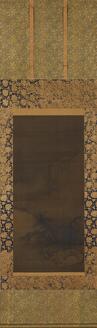
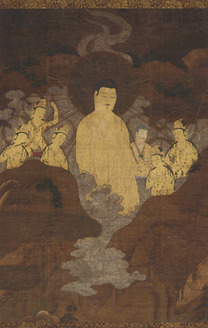
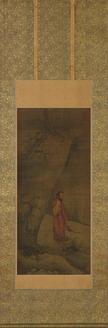
Bishamon Ten (Vaiśravaṇa), Extermination of Evil (J., Hekija-e)
辟邪絵 毘沙門天像
Paintings · Heian, 12th centuryNara NM
Home › Browse › Paintings › Kamakura period › Five Great Myōō (Vidyārājas)

This is a painting of the Five Great Wisdom Kings (Godai Myōō), important deities who are emanations of the Wisdom Buddhas. Fudō Myōō (Skt. Acala) is at the center and flanked by two child attendants; the rest are, clockwise from the lower right, Gōzanze Myōō (Skt. Trailokyavijaya) of the east; Gundari Myōō (Skt. Kuṇḍalī) of the south; Daiitoku Myōō (Skt. Yamāntaka) of the west; and Kongōyasha (Skt. Vajrayakṣa) of the north. The painting is of great significance as one of the oldest that combines the five deities in a single painting. {br=>[[]], content=>[This scroll of five Buddhist Deities or Five Myō'ō (Vidyārājas) depicts Fudō (Acalanātha, the deity in the center), Gōzanze (Trailokyavijaya, the deity in the eastern detection), Gundari (Kuṇḍali, the deity in the southern direction), Dai-itoku (Yamāntaka, the deity in the western direction) and Kongō-yasha (Vajrayakṣa, the deity in the northern direction). It had been common since the early Heian period to paint the five deities in five separate scrolls, but later the five deities began to be painted on only one sheet with Fudō-myō'ō being the central figure that was surrounded by the other four deities. There is an extant drawing of the five deities painted in the latter style made between the late Heian and the early Kamakura periods., The image of Fudō, which is introduced in this article, is iconographically closer to the Shōren-in version of the Blue Fudō painting.
Fudō's facial expression is similar to what is called \Genchō style\, although the modeling of the body of this Fudō is more robust than that of the Blue Fudō. The two boys added to Fudō in this painting are modeled after the examples in Hōraku-ji and Ruri-dera temples. Of the two boys in this painting, the image of Seitaka is copied from identical Genchō-style painting in Daigo-ji temple. The four deities which do not include Fudō are iconographically similar to their counterpart images of the painting with the same motif kept in Daigo-ji temple. Because they are similar to the images of Enshin-style deities introduced in the Besson-zakki, a collection of icons, it is conceivable that the images of the deities discussed in this article were modeled after several earlier icons. Mild colors which have dignity, effective shading, and lively brush strokes show the characteristics of Buddhist paintings in the Kamakura period. It is one of the rare examples in which the five deities were painted on a single scroll.]}
— Museum description: Nara National Museum (CC BY 4.0), via ColBase / Japan Search.