National Treasure

The Eccentrics Hanshan and Shide (From a Scroll of Zen Paintings)
寒山拾得図(禅機図断簡)
Paintings · Nanbokuchō, 14th centuryTNM
Home › Browse › Paintings › Nanbokuchō period › Xianzi, the Clam Monk

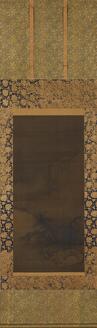
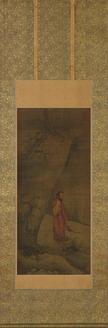
A man holding a net in his left hand is picking something up with his right. If you look closely, you can see that the thing in his right hand is a shrimp. This is a painting of Xianzi, a Chinese Zen Buddhist monk who lived in or around the 9th century, during the Tang dynasty (618–907). Xianzi had no fixed residence. He lived by catching shrimp and clams out of rivers during the day and sleeping in small, wayside shrines by night. The Xianzi in this painting must have just fished a shrimp at the waterside. There is something happy about his expression as he looks up at the shrimp. He looks as if he might just pop it into his open mouth. Take a closer look at the brushwork. Xianzi’s face, hands, and feet in the center of the painting are drawn using fine lines, but they have firm, solid outlines.
In contrast, Xianzi’s beard and clothes, as well as the ground, rocks, and trees are skillfully depicted with lines of varied weights despite using thin ink and rapid brushstrokes. The painting consists of only a small number of brushstrokes, but the painter succeeded in creating a vibrant atmosphere that evokes Xianzi’s personality by using different types of brushwork for different sections. Based on the seal in its bottom-right corner, this painting is believed to be the work of Kaō Ninga. He is said to have been active in the first half of the 14th century, but the details of his career are not known.
— Museum description: Tokyo National Museum (CC BY 4.0), via ColBase / Japan Search.