National Treasure

Hue of the Water, Light on the Peaks
山水図(水色巒光図)
Paintings · Muromachi, 15th centuryNara NM
Home › Browse › Paintings › Nanbokuchō period › White-Robed Guaneum (Pāṇḍaravāsinī)
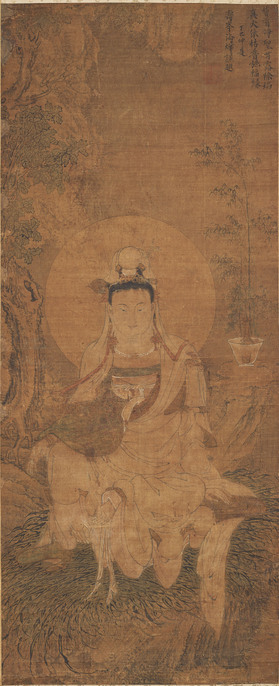
In this painting, Kannon (Avalokiteśvara) wearing a white garment over the head is seated on a rock. This composition, however, is not included in any Buddhist scripture, and it does not belong to the iconographic type of Byakue Kannon (Pāṇḍaravāsinī) introduced in the Rengebu-in or the lotus section of the Taizō-kai (Garbhadhātu or womb) Mandala. The orthodox type of Kannon in a White Garment is, as is seen in the Taizō-kai Mandala, usually presented in front of a big old tree on a steep mountain with deep valleys. But the type of Kannon introduced in this article which is different from the orthodox type, was probably established during the Tang dynasty in China without any reference to Buddhist texts. The grasses on the rock are depicted with sharp brush strokes. On the left side of Kannon a willow branch in a vase is placed within a crystal bowl, and slender bamboo stalks are described behind it.
The outline of Kannon's body and drapes are both drawn in ink with sharp brush strokes which indicate the skillful drawing technique of the artist. The interesting aspect about this painting is that the artist described Kannon with an air of the familiar human being. The painting is rendered in a craftsman-like skillful painting technique. Since the painting style of this picture differed from Chinese and Japanese styles, it is very likely that it was made in Korea during the Koryo dynasty. The inscription is about the virtue of Kannon. The inscription writer by the name of Kaika has not been identified. The date written in the inscription is 1377.
— Museum description: Nara National Museum (CC BY 4.0), via ColBase / Japan Search.


