National Treasure

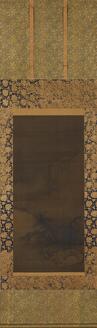
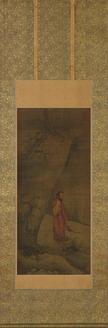
The Eccentrics Hanshan and Shide (From a Scroll of Zen Paintings)
寒山拾得図(禅機図断簡)
Paintings · Nanbokuchō, 14th centuryTNM
Home › Browse › Paintings › Nanbokuchō period › The Monk Xuanzang
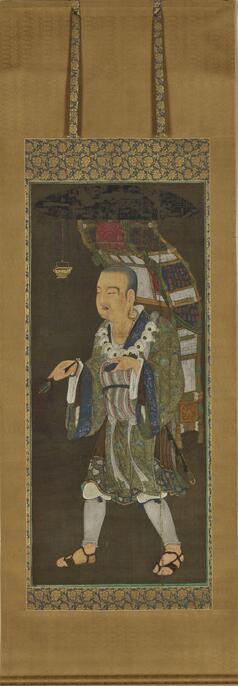
The monk Xuanzang (602-64) is shown in mid-stride, with a backpack full of sutra scrolls. His monumental achievement was bringing these scrolls from India to China and translating them. This is a Japanese painting of the Chinese monk Xuanzang Sanzang, who also features as a character in Journey to the West, a classic work of Chinese literature. Xuanzang travelled around India and collected many Buddhist sutras, which he then brought back to China and translated into his native language. This portrait shows Xuanzang facing to the left. The stories portrayed in illustrated handscrolls proceed from right to left, a principle that also applies to hanging scrolls such as this one. By showing Xuanzang walking from right to left, it seems that the artist wanted to depict him in the process of travelling from place to place and collecting Buddhist sutras. Take a closer look at Xuanzang himself, who is portrayed with surprising detail.
His mouth is open as though he were reciting a sutra, while his eyes and nose are also full of life. The shading of the face, which produces a subtle three-dimensionality, suggests influence from Buddhist paintings that were imported to Japan in great numbers from the port of Ningbo in Zhejiang province of China. Looking at Xuanzang's backpack, we can see that it is full of rolled-up sutra scrolls that he collected during his travels. He also wears a necklace of skulls around his neck. In one hand he carries a horsehair fly-swatter, which is actually a Buddhist implement, and in the other he holds a sutra scroll. He has a sword at his waist, straw sandals on his feet, and a sash around his waist, which is tied in an unusual manner. This painting is very rare, as there are very few extant works that depict Xuanzang by himself during his travels.
— Museum description: Tokyo National Museum (CC BY 4.0), via ColBase / Japan Search.