National Treasure

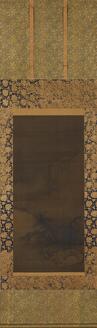
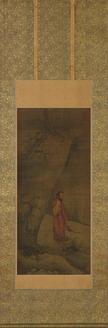
The Eccentrics Hanshan and Shide (From a Scroll of Zen Paintings)
寒山拾得図(禅機図断簡)
Paintings · Nanbokuchō, 14th centuryTNM
Home › Browse › Paintings › Nanbokuchō period › The Bodhisattva Kannon of the Wish-Granting Jewel and Dharma Wheel

The deity Nyoirin Kannon sits atop a boulder on a verdant mountainside, his eyes downcast in silent contemplation. Nyoirin Kannon is said to fulfill people’s every wish and is depicted here pondering how to save humanity. The spot his left hand touches gleams golden. In the sutras, which explain the teachings of Buddhist deities, it is written that Nyoirin Kannon touches the “shining mountain,” Mount Potalaka. This painting alludes to that detail by depicting him touching a gleaming golden rock. The artist is Ryōzen, who was active in the vicinity of Tōfuku-ji Zen Temple in Kyoto during the 14th century. The painting bears Ryōzen’s signature in its bottom-right corner. No details about Ryōzen are known, but it is rare for the name of the artist of a 14th-century work to survive, making this a valuable example. This is an ink wash painting. The artist portrays a space with depth through the use of different shades of ink.
The use of gold causes Nyoirin Kannon to stand out against the black ink used for the majority of the painting. Details such as the deity’s diadem, accessories, the pattern on his robe, and the veins on the leaves of the lotus throne on which he sits are delicately portrayed using gold paint made from a gold-powder base. Similar uses of gold paint are often seen in traditional paintings of Buddhist deities. In this painting, the gold-painted sections appear especially vivid amid the varied shades of black ink. The 14th-century painter Ryōzen was active in the vicinity of Tōfukuji, a Zen Buddhist temple in Kyoto. Here, he painted the compassionate Buddhist deity Kannon, who is said to fulfill people’s every wish. From his body emanates a circle of light indicating his fully awakened mind. His attire, intricately decorated with gold pigment, contrasts with the skillful application of monochrome ink.
— Museum description: Tokyo National Museum (CC BY 4.0), via ColBase / Japan Search.