National Treasure

Seated Yakushi Nyorai (Sk. Bhaiṣajyaguru)
薬師如来坐像
Sculpture · Heian, 9th centuryNara NM
Home › Browse › Sculpture › Heian period › Standing Eleven-headed Kannon (Jp. Jūichimen Kannon, Sk. Ekādaśamukha)
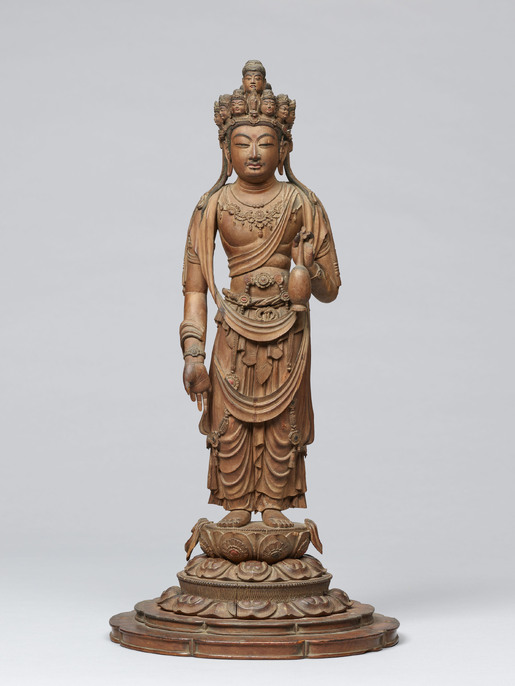
{i=>[danzō], content=>[Sandalwood and other fragrant precious woods have been highly valued as an ideal material for making Buddhist images since ancient times. Icons made from fragrant wood are known as , , and this Eleven-Headed Kannon perfectly exemplifies images of this type in its material and minutely carved details. It is in complete accordance with scriptural instructions for producing images of this iconography, down to its height.]} This variety of wood sculpture, known as danzō, exploits to fullest extent the color and fragrance of the medium of sandalwood. The portions that project outward from the main body have been carved from same block of wood. Although the trunk is slight and slender, the boldly executed facial features, the prominently chiseled head, and the bent-armed pose are replete with a powerful expressiveness. This variety of wood sculpture, known as danzō, exploits to fullest extent the color and fragrance of the medium of sandalwood. The portions that project outward from the main body have been carved from same block of wood. Although the trunk is slight and slender, the boldly executed facial features, the prominently chiseled head, and the bent-armed pose are replete with a powerful expressiveness. Almost the whole body of this statue, including the ten heads and the image of kebutsu on the main head, the vase in its left hand, and other details were carved from a single piece of sandalwood. Added parts are the topknot on the head, the part of the rosary which is not touching the body (missing), and flower-shaped ornaments on the lotus petals of seat. The platform is also made from a different piece of sandalwood, and a firm column which was carved out from the bottom of the lotus seat is inserted into the platform. The fragrance of sandalwood still surrounds this column. The beautiful surface of the sandalwood is effectively used without coloring, except for the hair, which is painted in navy blue, the rosary which is painted in red and blue, and the vase and costume, which are decorated with designs in gold pigment. The narrow eyes suit the gallant look of the young man, and its standing posture with its waist slightly twisted represents youthful ingenuousness. This is one of the representative examples of sandalwood sculptures made during the early 9th century in the early Heian period. {br=>[[], []], i=>[tenne, yōraku, yōraku, Eleven-Headed Kannon Heart Dharani Sutra ], content=>[Sometimes Buddhist statues were carved from expensive aromatic wood used for incense.
This one is made of sandalwood, which was valued for its color in addition to its scent. It has features unique to small statues, including a large head and truncated shins. Although the body is slim, the elbows turn outward with one arm lowered to produce a relaxed, fluid sense of movement that reflects the refined style of the early Heian period (794–1185). Despite its small size, the artistry in the statue’s enlarged facial features and full depth of its head is similar to the majestic appearance of a contemporaneous sculpture of the buddha Seated Yakushi (Skt. Bhaiṣajyaguru) at Shin-Yakushiji Temple., Elements that appear to be separate from the body were actually sculpted from the same block of wood and meticulously carved, including the personal adornments, attributes, and ornamental scarf-like strip of cloth (, ). Other small pieces of wood were used for most of the back of the bodhisattva’s bound hair, the right forearm, and part of the necklace-like ornamental chains (, ). The sculpture was mostly left with its original wooden finish, excluding pigments applied to the bound hair (blue), lips (red), eyebrows (ink) and , (red and blue) as well as patterns in gold paint along the hem of the wraparound skirt and water pitcher. The downward-facing lotus petals and base of the pedestal are made from a different material, and the floral decorations on the surface of the lotus petals are made from small pieces of wood. , Apart from some of the faces on the left, the other faces among the eleven are calm. Three of the faces on the right have lower fangs. The scriptural basis for this depiction is the , , particularly in the first Chinese translation by Jñānagupta (523–600 ) during the Northern Zhou dynasty (557–581) or the second translation by Atikūta (ca. seventh century) during the Tang dynasty (618–907), whi ch say “the bodhisattva’s face has canine-like fangs protruding upward.” The faces on the left, however, have wrathful appearances like heavenly kings that are likely based on the third translation d escribing “wrathful faces” by Xuanzang (602–664) during the Tang dynasty. The statue notably bases its depiction on earlier translations but also incorporates parts of what would have been the latest translation of the day.]}
— Museum description: Nara National Museum (CC BY 4.0), via ColBase / Japan Search.


