National Treasure

Seated Yakushi Nyorai (Sk. Bhaiṣajyaguru)
薬師如来坐像
Sculpture · Heian, 9th centuryNara NM
Home › Browse › Sculpture › Nara period › Standing Eleven-headed Kannon (Ekādaśamukha Avalokiteśvara)
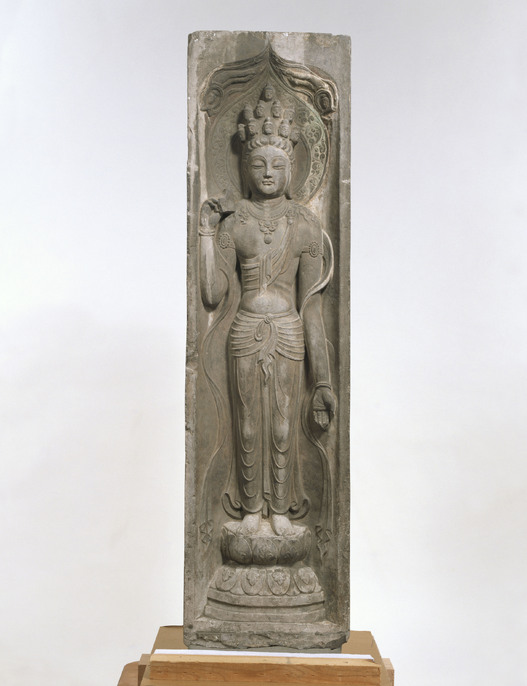
This image is one of the seven statues of Eleven-Headed Guanyin (Jūichimen Kannon) from the statue group in Baoqinsi Temple in China’s present-day Xi’an, Shaanxi Province. The right hand holds a seal with the words “Extinguish Sin.” This attribute reflects belief in Avalokiteśvara’s capacities at expiating bad karma. This image is one of the seven statues of the Eleven-headed Kannon from statue group in Baoqingsi Temple, Xi’an, Shaanxi, China. The right hand holds a seal bearing two characters which means “extinguish one’s sin” and indicates salvific power of the Avalokiteśvara. This work was built in a sophisticated style with rounded face and slender frame. {br=>[[], [], [], []], i=>[Dharani Sutra of the Thousand-Eyed and Thousand-Armed Bodhisattva Who Regards the World’s Sounds and Feels Vast, Complete, Unimpeded Great Compassion, Commentary on the Great Cloud Sutra], content=>[This work is one of several stone relief sculptures that were previous installed in the Buddhist hall and pagoda of Baoqingsi Temple in the present-day city of Xi’an in Shaanxi Province, China. The sculptures were originally part of the Tower of Seven Treasures (Ch. Qibaotai) at Guangzhaisi Temple, which was built between Chang’an 3 (703) and Chang’an 4 (704) by Empress Wu Zetian (624–705; r. 690–705). Her close advisor the priest Degan (dates unknown) oversaw the project. Empress Wu temporarily changed the name of the country from Tang to Zhou (also called Wu Zhou) in an attempt to form her own dynasty. , Thirty-two reliefs are known to exist today, including six that remain in Baoqingsi’s seven-story hexagonal pagoda, which was reconstructed in the early Qing dynasty (1644–1911). Among these, seven depict the Eleven-Headed Bodhisattva Guanyin (J. Jūichimen Kannon; Skt. Ekādaśamukha-avalokiteśvara). All of them reflect typical styles of the Tang dynasty (618–907) that incorporated Indian sculptural modes and are highly valuable as reference works from state-sponsored workshops in the Tang capital of Chang’an at that time.
, Carved to form a niche in a rectangular slab of limestone, this relief shows the Eleven-Headed Guanyin standing on a lotus pedestal with a sacred jewel-shaped halo. The figure’s round face and mil d gaze form an elegant countenance, and a thin robe clings to the lower body, revealing a slender appearance. The bodhisattva’s additional heads are arranged in rows of one, four, and five from top to bottom, with the right arm bent to hold a seal reading “expiation [of sins],” and the left hanging downward with the palm facing forward. , Reliefs of the Eleven-Headed Guanyin from Baoqingsi Temple hold a variety of attributes in their hands. Those like this one holding a seal may be related in some way to the “jeweled seal” that is one of the attributes held in Guanyin’s forty main arms when depicted in the thousand-armed form (J. Senju Kannon; Skt. Sahasrabhuja-avalokiteśvara). This iconography is described in the , (Ch. Qianshou Qianyan Guanshiyin pusa guangda yuanman wu’ai dabeixin tuoluoni jing). The use of the two characters meaning “expiation,” however, is reminiscent of a repentance ceremony in Japan called the Shuni-e that is performed before statues of the Eleven-Headed Bodhisattva Kannon at Nigatsudō Hall at Tōdaiji Temple. The seal’s inscription has been highlighted for its importance in studying the nature of faith in Guanyin’s manifestations during the Wu Zhou period. , Guangzhaisi Temple was constructed by imperial order in G uangzhai ward, a site where thousands of Buddhist relics were said to have been discovered in Yi feng 2 (677). This discovery is described in the , (Ch. Dayun jing shu), an apocryphal text written to legitimize Empress Wu’s rule. The Tower of Seven Treasures and its accompanying Buddhist stone reliefs seem to have been part of a concerted effort to use Buddhism to support Empress Wu’s claim to the throne. ]}
— Museum description: Nara National Museum (CC BY 4.0), via ColBase / Japan Search.


