National Treasure

Seated Yakushi Nyorai (Sk. Bhaiṣajyaguru)
薬師如来坐像
Sculpture · Heian, 9th centuryNara NM
Home › Browse › Sculpture › Heian period › Standing Tamonten (Sk. Vaiśravaṇa)

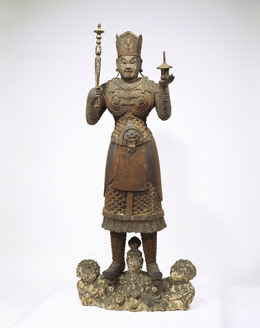
Here Tamonten (Skt. Vaiśravaṇa) holds his attribute of a pagoda raised up high, a type of image that was widespread in Nara. With the strong twist of the hips to the right, it expresses dramatic movement and a powerful dynamism. It was previously part of a set of sculptures from Kōfukuji Temple along with the Zōchōten (Skt. Virūḍhaka) now in the collection of the Nara National Museum. This statue of Tamon-ten with an ornamental pagoda held high aloft is representative of a style widely seen in the Southern Capital (Jpn. Nanto), as Nara was once known. In addition to the pose in which the waist is twisted to the right, the statue has a dynamism that can only be called dramatic. Originally kept at Kōfukuji temple, it one of Four Guardian Kings (Jpn. Shitennō) and was paired with Kōmoku-ten. This work constituted as the one of the Four Guardian Kings and came from Kōfuku-ji Temple together with the Kōmokuten (Skt. Virūpāṣa) and the Zōchōten (Skt. Virūḍhaka). The waist was twisted rightward and the right hand was raised aloft holding the small pagoda, characterized a lively posture. The black eye was inlaid with different block of wood to emphasize the raging face. {i=>[Zōchōten (Skt. Virūḍhaka)], br=>[[], []], content=>[The Four Heavenly Kings guard the four cardinal directions. The deva Tamonten (Skt. Vaiśravaṇa) is the guardian of the north. This statue belongs to a set of the Four Heavenly Kings that was reportedly passed down at the Northern Round Hall of Kōfukuji Temple, but its actual origins are unknown. The three other statues in the set have also survived to present day (see the entry for , )., This statue wears a fierce expression, scowling with wrathful eyes and an open mouth.
The helmeted head is turned to the viewer’s left. Its piercing gaze is focused on a jeweled stupa held in the palm of its upheld right arm. Holding a sacred staff in the lowered left hand, the statue stands with its hips twisted to the right as it tramples an evil demon’s head under its right foot and stomps down on the demon’s backside with its slightly outturned left foot. Tamonten has a vividly rendered wrathful countenance, short neck, and stocky body. The somewhat muted dynamism in the pose, however, and fullness of the figure’s form call to mind the dignified appearance of statues with their main bodies sculpted from a single block of wood during the early Heian period (794–1185). , The torso of this work is carved from a single block of Japanese cypress that was hollowed out and has had a board attached to the back. The head was made from a separate piece of wood and attached at the neck . The eyes were faced in a different material, and the work was painted. The scales in the figure’s lamellar armor are adorned with gold leaf adhered with lacquer. These features are shared with the Museum’s statue of Zōchōten, and both are thought to have been created by Buddhist sculptors in Nara in the late Heian period. As described in the commentary for the Zōchōten statue, the full-bodied and impressive life-size renderings in this set make them part of a lineage of Four Heavenly King sculptures produced in Nara from the late Heian period to the early Kamakura period (1185–1333).]}
— Museum description: Nara National Museum (CC BY 4.0), via ColBase / Japan Search.