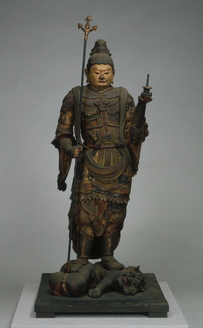
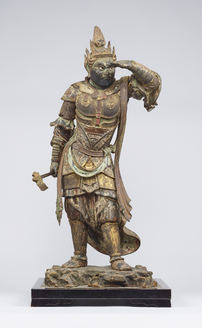
Important Cultural Property
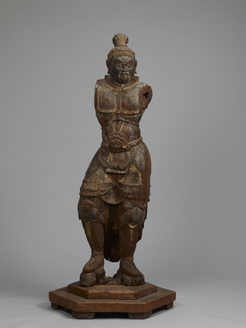
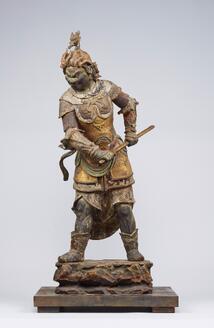
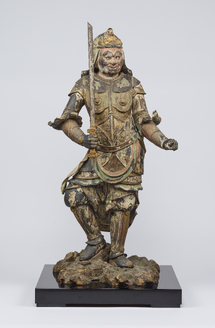
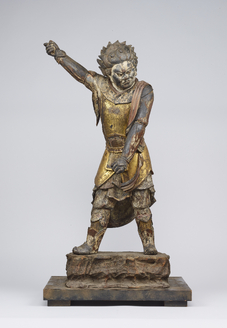
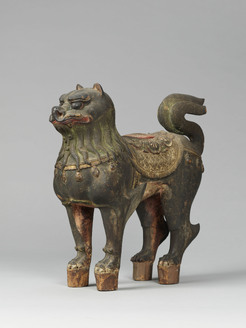
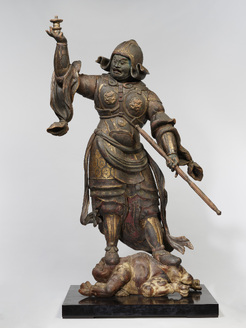
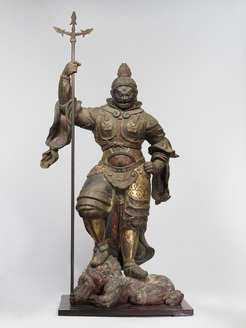
Standing Tenno (Deva King)
天王立像
Sculpture · Heian, 901–1100TNM
Home › Browse › Sculpture › Heian period › The Wisdom King Fudō
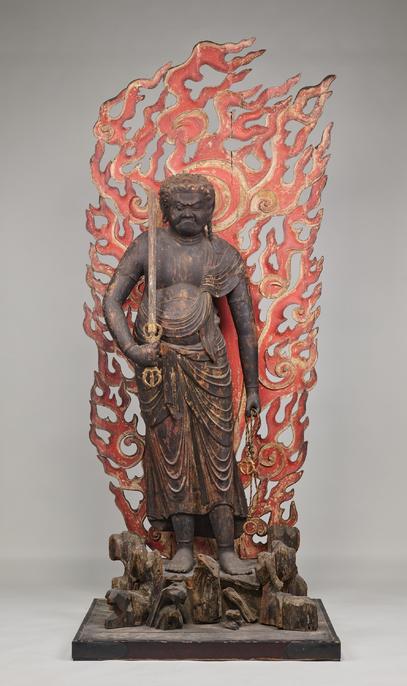
The buddhist pantheon includes a variety of buddhist deities with different names, appearances, and roles. In esoteric buddhism, a deity called Dainichi was believed to stand at the center of the universe. Wisdom kings are avatars of Dainichi who serve to promote stronger faith in Buddhism by displaying their furious expressions and menacing appearances. Many wisdom kings therefore have terrifying faces, red or blue skin, or hold weapons. The wisdom king Fudō is a typical example. He has been worshipped in Japan since the 9th century, during the Heian period (794-1192), and many renowned sculptures and paintings of him survive to the present day. This is a statue of the wisdom king Fudō. It is carved from cypress wood and its surface painted. The wisdom king strikes a powerful pose, with his right shoulder squared and his weight on his right foot. He holds a sword in his right hand and a rope called a pasha dangled from his left. These are not weapons for defeating enemies; they mean that the wisdom king cuts through worldly desires with his sword and saves people with his rope. The wisdom king Fudō has two basic appearances. In one, he is depicted with his hair swept back and the tied ends draped over his left shoulder, both eyes open and biting his lower lip with his upper lip.
This sculpture represents the other type, with curly hair, the tied ends of which are draped over his left shoulder, his left eye closed and fangs protruding from between his lips. Refined taste is apparent in the central arrangement of the wisdom king’s facial features, his somewhat subdued expression and the orderly lines of his robes. The image also retains old styles, which is apparent in the fact that, although its interior has been hollowed out, its trunk, including the head and center of the body, is carved from a single piece of wood, and in the heavy build of the wisdom king’s lower body. Wisdom kings are deities unique to [mikkyō], the “secret” teachings of Buddhism. Fudō is the most important wisdom king, and his name means “The Immovable One.” He holds a sword in his right hand and a rope dangling from his left hand. These are not weapons for vanquishing enemies. The sword cuts through greed and other worldly desires, while the rope is used to pull people toward the path of enlightenment.
— Museum description: Tokyo National Museum (CC BY 4.0), via ColBase / Japan Search.