Important Cultural Property

Dish with a Plum Tree
琺瑯彩梅樹文皿
Ceramics · Edo, 18th centuryTNM
Home › Browse › Ceramics › Edo period › Square Dish with a Chinese Poet Watching Seagulls

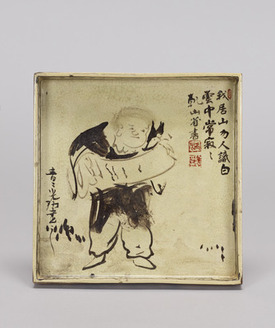
This is a square dish with a rim around 3 centimeters high. The dish was formed by pouring clay into a mold. A white clay slip was then applied to the surface and a design drawn in underglaze iron, with another transparent glaze then added and the dish fired in a kiln. The rim almost seems like a picture frame with its flower and cloud patterns. The central picture uses light brown lines to portray a waterside scene of a man in Chinese clothes watching two waterfowls frolicking. This is believed to be a depiction of the Song-period Chinese poet Huang Tingjian observing two seagulls. Perhaps the poet was admiring the free spirits of the gulls as they swooped through the air and floated on the water. The composition utilizes a lot of empty space and the sketches are rendered with a light touch reminiscent of ink painting. This imbues this work with a rich emotional quality found in a scroll of painting. The artist has signed his name on the bottom left. Born in Kyoto, Ogata Korin was one of the most prominent artists of the Edo period. This ethereal picture contrasts sharply with straightforward, solid script on the dish's underside.
This was written by Ogata Korin's younger brother Shinsei. It recounts how the dish was made by Shinsei and the picture by Korin. Shinsei is better known by the name 'Kenzan.' He opened a kiln in Kyoto to produce pottery and he was also involved in the design of ceramics, lacquerware, and other craft works. The two brothers often worked together to create pottery like this dish. They played a tremendous role in the development of culture in Kyoto and Japan in the 18th century, during the Edo period. Their activities were highly acclaimed by later generations under the moniker of the 'Rinpa School,' a name that derives from the second syllable in Korin's name. This work blurs the boundaries between painting and pottery. It was made in the early 1700s by two of Kyoto's leading artists, the brothers Shinsei and Kōrin. Shinsei formed the dish while Kōrin painted the surface with an image of Huang Tingjian (1045–1105), a Chinese poet widely celebrated in Japan.
— Museum description: Tokyo National Museum (CC BY 4.0), via ColBase / Japan Search.