Important Cultural Property
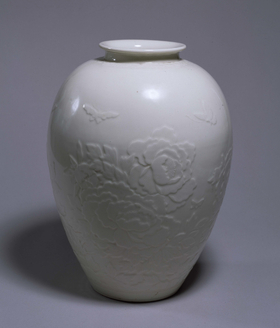
Large Vase with Butterflies and Peonies
白磁蝶牡丹浮文大瓶
Ceramics · Meiji and later, 1892TNM
Home › Browse › Ceramics › Meiji and later period › Footed Bowl with Crabs

At first glance, there seems to be two real crabs, one climbing atop the other, clinging to this bowl. Their shapes were molded out of clay and fired, with a glaze containing large amounts of crystalline substances then applied, and the crabs fired again to create an approximate color. More detailed colors were then painted on top using a variety of pigments, with the crabs fired a final time to create the finished product. In contrast, the bowl itself is significantly warped, with the glaze applied in a slapdash fashion. This serves to accentuate the realism of the crabs. Miyagawa Kozan was born in Kyoto and he moved to Yokohama during the Meiji era.
He produced many objects for European and American markets. As with this bowl, many of these exported ceramics feature realistic motifs. Japanese craft works like this were exported in volume and became very popular overseas at the start of the Meiji era, in the second half of the 19th century. Two crabs cling to the bowl, one climbing atop the other. Everything is made of clay, but the rough texture of the bowl emphasizes the realism of the crabs. The artist, Miyagawa Kōzan (1842–1916), made intricate pieces like this for export to Europe and America, where he became Japan’s most famous ceramic artist.
— Museum description: Tokyo National Museum (CC BY 4.0), via ColBase / Japan Search.