National Treasure

Hue of the Water, Light on the Peaks
山水図(水色巒光図)
Paintings · Muromachi, 15th centuryNara NM
Home › Browse › Paintings › Nanbokuchō period › Portrait of the Priest Myōkū
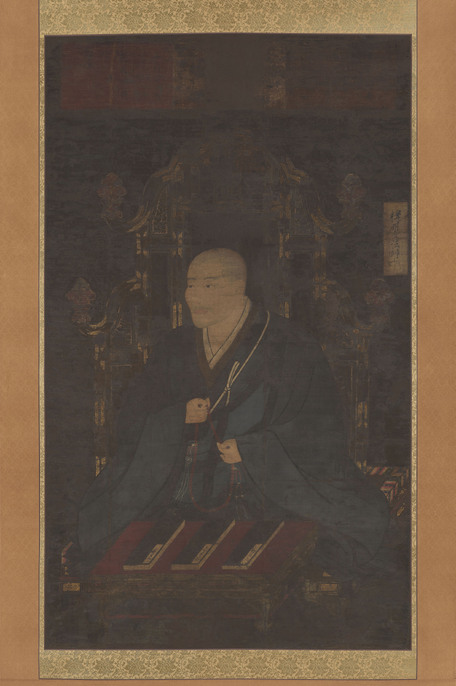
Shinran (1173–1263) was the founder of the Jōdo Shin sect of Pure Land Buddhism, and this is Myōkū (1225–1297), his influential disciple and a patriarch of the Jōdo Shin sect. Prior to ordaining, his name was Miura Tanemura, and he served as a vassal to the Kamakura shogunate. The contemplation sutras of fundamental importance to Pure Land faith are arrayed on the sutra stand in front of him. The upper portion of the portrait has an inscription that appears to be a passage from Shinran’s writings. This comes from Busshinji Temple in Shiga. The life of Priest Myōkū is not known well. According to one record, he, whose name before entering the priesthood was Miura Kōjirō Yoshitada, was a son of a vassal of the Shogun during the Kamakura period. He entered the priesthood after his father had died on the battle field.
He studied under Priest Shinran and opened Kōmyō-ji temple in Shimotsuma in Hitachi. Another record says his name had been Miura Tanemura, and when all his family was killed in 1247 he entered the priesthood. In the portrait introduced in this article he is seated on a chair, wearing a black Buddhist garment and a kesa robe, and holding a rosary in his hands. The triple Pure Land sutras are placed on the desk in front of him. His eyes, which indicate strong will power, as well as his robust body imply his strength and diligence which is rooted in his former career as a warrior. His name Shaku Myōkū Hōshi is written in a tanzaku-shaped rectangle within the painting, and a Buddhist poem by Zendō is written in the shikishi-shaped square at the top of the painting.
— Museum description: Nara National Museum (CC BY 4.0), via ColBase / Japan Search.


