National Treasure

Hue of the Water, Light on the Peaks
山水図(水色巒光図)
Paintings · Muromachi, 15th centuryNara NM
Home › Browse › Paintings › Nanbokuchō period › Monju (Mañjuśrī)
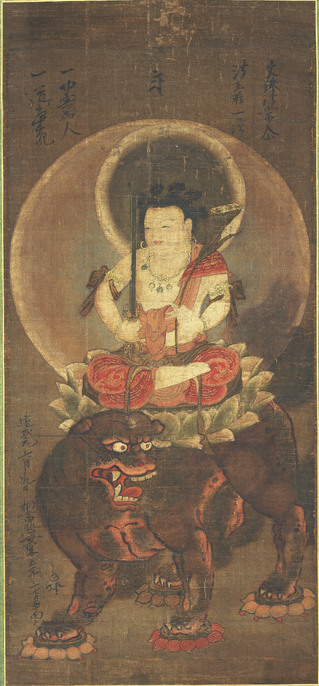
The youthful form of the bodhisattva Monju (Skt. Mañjuśrī) rides upon a lion, with a hairstyle of five topknots representing the five syllables of Monju’s shingon, or “true word,” the phrase manifesting the deity’s powers in the Vajrayāna Buddhist context. We learn from the inscription to the side of the deity that the Shingon priest Monkan Bōkōshin (1278–1357) had this painting made for the memorial services of his mother. He was an important priest; the Emperor Go-Daigo (1288–1339) is known to have confided in him. Monju-bosatsu (Mañjuśrī), who is considered to preside over wisdom, has been worshipped both as an independent Buddhist deity and as an attendant of Shaka (Śākyamuni or Buddha). In esoteric Buddhism Monju-bosatsu is usually represented as a boy. The figure is sometimes depicted with topknots in its hair, and four types can be distinguished by the number of topknots according to the number of holy letters: one, five, six, or eight.
Among these four types, the figure with five knots as depicted in this article is most popular. It is holding a sword, which symbolizes wisdom, in his right hand and a lotus stem, on which a Bonkyō-type sutra is placed, in his left hand. Monju-bosatsu riding on the back of a lion is very common scene. According to the inscription, it is known that Monkanbō Kōshin (1278-1357), who had the confidence of the Emperor Godaigo, made this painting on June 9, 1334 for the third period of seven days' anniversary of his mother's death. He made another Monju-bosatsu with eight top-knots on the fifth period of seven days' anniversary of her death. The decoration in gold pigment on the costume and strong brush strokes of the depiction of the lion reflect people's taste of the days when it was painted.
— Museum description: Nara National Museum (CC BY 4.0), via ColBase / Japan Search.


