National Treasure
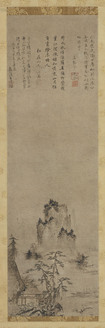
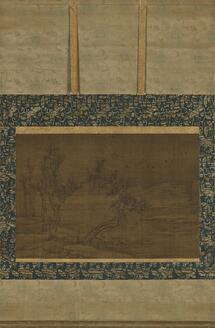
Hue of the Water, Light on the Peaks
山水図(水色巒光図)
Paintings · Muromachi, 15th centuryNara NM
Home › Browse › Paintings › Nanbokuchō period › Mandala of Ikoma Taisha Shrine

{i=>[honji butsu], content=>[Mount Ikoma is to the west of Nara City, and here we see the environs of Ikoma Taisha Shrine where the deities that guard over the mountain’s eastern foothills reside. Above the shrine buildings, these deities appear in their Buddhist forms (, ). A Shinto deity and attendants arriving from a distant shrine can be seen in the distance beyond them at the top of the mountain.]} {br=>[[]], content=>[This scroll is a rare example of Buddhist-Shintoist painting which illustrates the origin of shrine. The view of Ikoma shrine on the slope of Mt. Ikoma in Nara prefecture is depicted largely, and in the upper part of the scroll, Buddhist deities—from left to right, Monju (Mañjuśrī), Jizō (Kṣitigarbha), Jūichimenkannon (Ekādaśamukha), Shaka (Śākyamuni), Amida (Amitabha), Yakushi (Bhaiṣajyaguru), and Bishamon-ten (Vaiśravaṇa), who were enshrined as Shinto deities at seven sanctuaries on Ikoma—are painted. At the top of the picture, Shinto deity Usa-hachiman and his attendants, who came from Sumiyoshi beach by riding on a golden and silver moving cloud and landed at the top of Mt.
Ikoma, are depicted., In regard of the location of shrine buildings in this mandala painting, five sanctuaries are painted in the central part and two sanctuaries are arranged at the sides. The following persons were enshrined at the five sanctuaries in the center: the Emperor Ōjin, who was considered to be the Shintoist deity Hachiman, the Emperor Chūai, who was Ōjin's father, the Empress Jingū, who was Ōjin's mother, and Empress Jingū's parents. Those who were enshrined at the two other sanctuaries outside of the central part of the precinct were the male deity Ikomatsuhiko-no-mikoto and the female deity Ikomahime-no-mikoto, who were the original deities of Ikoma shrine. During the Mongolian invasions in the middle ages, Ikoma shrine invited deity Hachiman as the god of archery. That historical background implies the motivation for painting this picture.]}
— Museum description: Nara National Museum (CC BY 4.0), via ColBase / Japan Search.