National Treasure
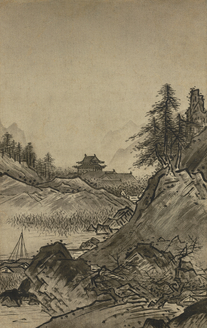
Autumn and Winter Landscapes
秋冬山水図
Paintings · Muromachi, 15th centuryTNM
Home › Browse › Paintings › Muromachi period › Landscape
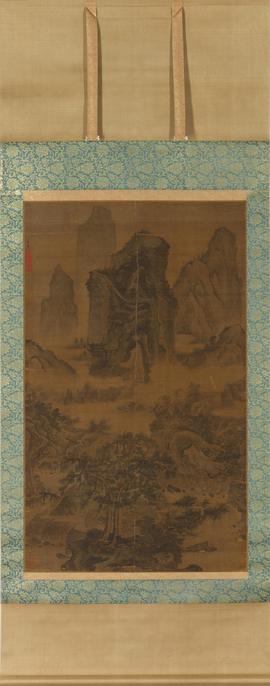
Li Zai was a landscape painter of the imperial court. The peak of the mountain leaves a sublime impression. Chinese landscape painting reached one of its zeniths in the 11th century, during the Northern Song dynasty. Guo Xi was one of the most prominent court painters from this period. The artist of this work, Li Zai, a Ming-dynasty court painter who was active in the first half of the 15th century, had carefully studied Guo Xi’s style of painting. Let us take a closer look at what this painting depicts. In the foreground, we see a few pine trees with sharp, pointed branches resembling crab claws. Streams of water flow on each side of where these trees stand, and if we trace them upstream, we reach craggy hills depicted to the left and right. Comparing the size of the trees on these hills with that of the pine trees in the foreground would enable one to perceive suddenly the depth of this scene. Behind these hills spreads a mist, and beyond that, a vertical world unfolds before us. Right in the middle soars a great mountain, with a number of peaks flanking it on either side, creating a bold, impressive appearance.
In the landscape paintings by Guo Xi, the 11th-century master who inspired Li Zai, mountains depicted in this way seem to have been interpreted as symbolic of the emperor. Li Zai has arranged his motifs of trees, streams, mist, and mountains neatly, almost symmetrically on both sides, creating a vast, beautiful world, with a majestic mountain in the center that looks as if it rules it all. Perhaps this was Li Zai’s way of showing his admiration for the emperor he served. When Sesshu, a renowned Japanese ink painter from the Muromachi period, returned from his journey to China, he talked proudly of having learned painting from Li Zai. Whether Sesshu ever actually was close enough to Li Zai to be taught anything from him is still a matter of debate today. Whatever the truth might be, this anecdote shows how Li Zai was regarded highly by the Japanese at the time as one of China’s most eminent landscape painters.
— Museum description: Tokyo National Museum (CC BY 4.0), via ColBase / Japan Search.