Treasures of JapanA catalogue of Japan's designated cultural properties 2,690 works catalogued

Home › Browse › Paintings › Muromachi period › Bodhisattva Monju Riding a Lion
Important Cultural Property

Bodhisattva Monju Riding a Lion

騎獅文殊図
Bodhisattva Monju Riding a Lion (騎獅文殊図)
PLATE IImage: Tokyo National Museum, via ColBase — CC BY 4.0
At a glance — Painting · Muromachi period, 15th century · held by Tokyo National Museum · designated Important Cultural Property of Japan · Reisai.

Fact Sheet

Designation
Important Cultural Property (重要文化財)
Category
Paintings
Date
1401–1500
Creator
Reisai (霊彩、竜岡真圭賛)
Location
Ueno, Tokyo
Catalogue ID
cobas-47472

Find more

Same creator
Reisai →

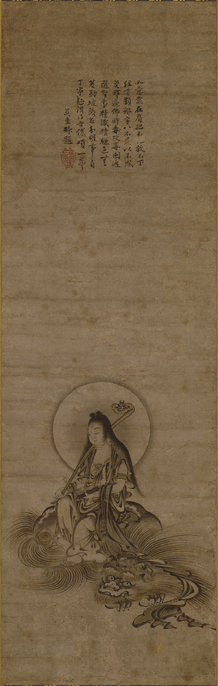
This is a picture of Monju Bosatsu, or Manjusri Bodhisattva in Sanskrit. It was painted by Reisai, a master of monochrome ink painting who was active during the 15th century. Reisai's distinctive charm lies in the smooth, versatile brush lines, infused with a sense of speed. The lines of the robe shift abruptly from thin to thick, for instance, while the fine, delicate lines of the shishi lion radiate softness. His most characteristic lines are probably those curved like the letter 'W', as seen on the garment covering the Bodhisattva's feet. These lines create a sense of texture and three-dimensionality unique to Reisai's works. He certainly deserves to be called the master of lines. Another striking feature is the use of gold pigments.

Though the outline of the ceremonial scepter is sketched in black ink lines, for example, the scepter's inner section is decorated with gold lines. The other accessories of the deity are also rendered in gold. Further inspection reveals fine gold strokes painted between the ink lines of the lion's fur. Reisai's signature-seal is also written in gold to the bottom right of the lion. These details may be hard to discern through a glass exhibition case, but feel free to take a closer look. Finally, note how the circle of light behind the deity's head is formed by gradations of black ink, without any clear outline. This expression of radiant light is typical of monochrome ink Buddhist paintings.

— Museum description: Tokyo National Museum (CC BY 4.0), via ColBase / Japan Search.

Record & Sources

Cite this page: “Bodhisattva Monju Riding a Lion(騎獅文殊図).” Treasures of Japan, catalogue no. cobas-47472. Tokyo National Museum. https://treasures.yamato-kenkou.com/treasures/bodhisattva-monju-riding-a-lion/ — entry last verified 1 November 2026.
Full record data (as published in the official catalogue record)
  • Genre: Painting
  • Cultural property designation: Important Cultural Property
  • Material: Ink and gold on paper
  • 員数: 1幅
  • 分類: 絵画
  • Inscriptions: 龍崗真圭賛
  • 作者: 霊彩筆、龍崗真圭賛
  • 品質形状: 紙本墨画金彩
  • 銘文等: 龍崗真圭賛

Also at the Tokyo National Museum More →

National Treasure
Landscape (破墨山水図)

Landscape

破墨山水図
Paintings · Muromachi, 1495TNM
National Treasure
Pine Forest (松林図屏風)

Pine Forest

松林図屏風
Paintings · Muromachi, 16th centuryTNM
National Treasure
Cypress Trees (檜図屏風)

Cypress Trees

檜図屏風
Paintings · Azuchi-Momoyama, 1590TNM
National Treasure
Snowy Landscape (雪景山水図軸)

Snowy Landscape

雪景山水図軸
Paintings · Kamakura, 1201–1400TNM

More paintings of the Muromachi period More →

National Treasure
Landscape (破墨山水図)

Landscape

破墨山水図
Paintings · Muromachi, 1495TNM
National Treasure
Chinese Lions (唐獅子図屏風)

Chinese Lions

唐獅子図屏風
Paintings · Muromachi, 16th centurySannomaru Shozokan
National Treasure
Pine Forest (松林図屏風)

Pine Forest

松林図屏風
Paintings · Muromachi, 16th centuryTNM
Advertisement