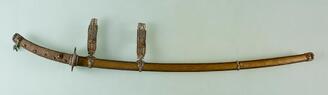
National Treasure

Blade for a Long Sword (Tachi)
太刀
Swords & Armour · Kamakura, 1327TNM
Home › Browse › Swords & Armour › Kamakura period › Blade for a Long Sword (Tachi), Named “Koryū Kagemitsu”

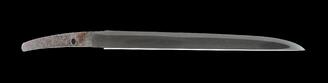
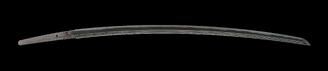
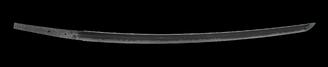
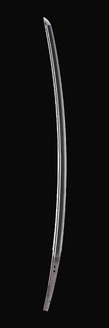
A prominent work of Kagemitsu, a member of the Osafune school in present-day Okayama prefecture, this sword features a texture and temper pattern of exceptional brilliance. The tang of a sword is the blunt, narrow part around which the hilt, or grip, is fitted. When the sword is stored away, the tang is fitted into a hilt and the sword is sheathed in a scabbard. The upper section of this sword's tang features relief images of a dragon entwined around a sword on one side and a Sanskrit character on the other. The dragon is a depiction of Kurikara Ryuo, the dragon form of Fudo Myoo, or Acalanatha in Sanskrit, with the Sanskrit character also representing the Buddhist deity. Fudo Myoo was believed to burn away all hindrances and problems, so he was often engraved on Japanese swords. The length of this sword was shortened as it passed down from owner to owner, so when the tang is fitted into the hilt, the dragon is partially concealed and appears quite small.
For this reason, the sword is known as “Koryu Kagemitsu.” “Koryu” means “small dragon” in Japanese, while “Kagemitsu” refers to the sword's creator. Kagemitsu belonged to the Osafune school of swordsmiths and he was active in the first half of the 14th century in the southern part of modern-day Okayama prefecture. This sword is renowned as one of his representative works. The metal surfaces of Japanese swords have wood grain patterns that resemble the rings of a tree. The extremely-fine pattern on this sword appears black and it contrasts with the whiteness of the blade edge. A gleaming temper pattern conveys a sense of tension as it sits between these two extremes. As the accompanying diagram shows, the temper pattern features small semi-circles that all incline in the same direction. This is a common trait of swords made by Kagemitsu and his pupils.
— Museum description: Tokyo National Museum (CC BY 4.0), via ColBase / Japan Search.