National Treasure
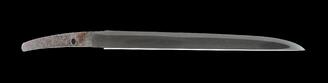
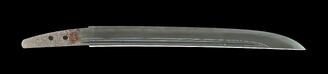
Blade for a Dagger (Tantō)
短刀
Swords & Armour · Nanbokuchō, 14th centuryTNM
Home › Browse › Swords & Armour › Nanbokuchō period › Blade for a Long Sword ("Katana")

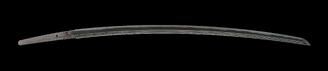
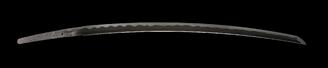
This sword was handed down by the Echizen Matsudaira Clan as a sword used by Yuki Hideyasu, the second son of the samurai ruler of Japan, Tokugawa Ieyasu. The length of the blade was subsequently shortened, and the signature of the swordsmith has been lost. However, it is believed to be the work of Motoshige, a swordsmith of the Osafune school from Bizen Province, an area located in southwest Japan. Motoshige was active during the 14th century. The blade is wide with a shallow curve and a long, straight tip, all distinctive features of swords from that period. Another major highlight is the sword's temper pattern, which is made when the blade is hardened. This pattern, which runs the length of the blade, seems to slant downwards, and exemplifies the unique characteristics of Motoshige's swords.
The sword's beauty can be better appreciated by viewing it from several different angles. The sword’s mounting and sheath display an unconventional beauty with a red lacquer coating decorated in gold and silver. In Japan, some of the largest and most robust swords were created in the 1300s, an era when the samurai began to fight more on foot rather than on horseback. This one, crafted by the master swordsmith Motoshige, illustrates this trend with its large point and wide blade. Originally longer, it was later shortened to make it easier to use in close quarters.
— Museum description: Tokyo National Museum (CC BY 4.0), via ColBase / Japan Search.