National Treasure
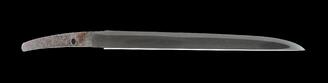
Blade for a Dagger (Tantō)
短刀
Swords & Armour · Nanbokuchō, 14th centuryTNM
Home › Browse › Swords & Armour › Nanbokuchō period › Armor ("Dōmaru") with Black Lacing, White at the Top
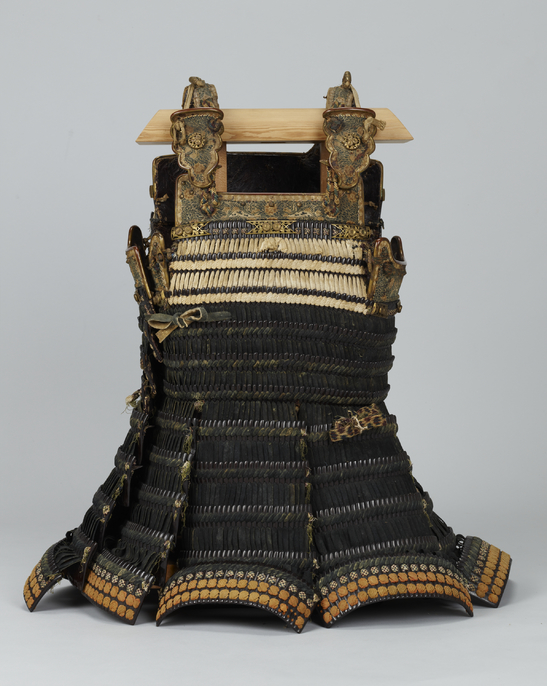
There are many different types of Japanese armor. This armor with a cuirass, known as a dōmaru, wraps around the torso and fastens on the right side. It is not definitely known what the origins of this armor are, but it is believed to have first been used by samurai who fought on foot. In the late-15th century, examples with helmets to protect the head and sleeves to protect the arms began to appear, and the armor is thought to have been used by high-ranking samurai around this time as well. This armor is made up of small, card-like platelets of iron or leather called sane, which are lacquered and bound together with cords of deer leather or braided silk. The white braided cord on the chest and the deep-indigo-dyed deer leather used to bind most of the rest of this armor together are particularly decorative.
This armor is a good example of the characteristic features of 14th and 15th-century dōmaru. For instance, the tassets, which protect the thighs, are finely segmented for ease of movement, and the iron breast- and sideplates are covered in dyed leather with a pattern of algae and lions. The [dōmaru] (“torso wrapper”) is a type of lightweight armor originally designed for foot soldiers. Its skirt is divided into multiple sections for greater mobility. This is one of the few [dōmaru] that have survived from the 1300s. Its intricate construction, featuring gilt ornaments and braided silk cords, suggests it was specially commissioned for an elite samurai.
— Museum description: Tokyo National Museum (CC BY 4.0), via ColBase / Japan Search.