National Treasure

Commentary on Vajracchedikā-sūtra, by priest Kūkai
空海筆 金剛般若経開題残巻(三十八行)
Calligraphy & Books · Heian, 9th centuryNara NM
Home › Browse › Calligraphy & Books › Kamakura period › Segment of Konkōmyō-Saishō'ō-kyō (Suvarṇaprabhāsottama sūtra)
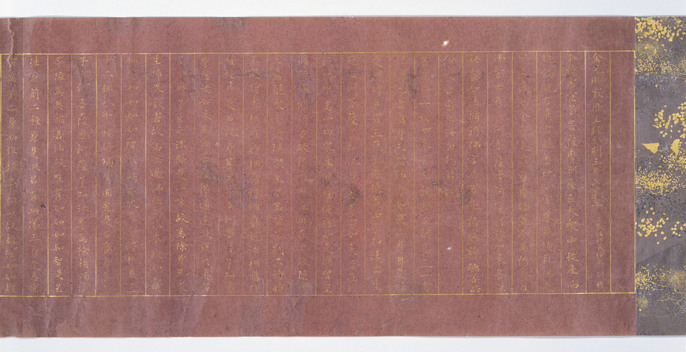
{i=>[Golden Light of the Most Victorious Kings Sutra, Suvarṇa-prabhāsôttama-sūtra, Jinguangming zuishengwang jing, Konkōmyō saishōō kyō], content=>[This scroll of the , (Skt. , ; Ch. , ; J. , ) was copied by the Kamakura-period Emperor Go-Uda (1267–1324; r. 1274–1287), an ardent Buddhist. He perhaps made this copy in emulation of Emperor Shōmu (701–756; r. 724–749), creating sutras to be enshrined throughout the country. In the Nara period (710–794), Shōmu had the same sutra copied in gold ink on purple paper and distributed to provincial temples throughout the realm.]} {br=>[[], []], content=>[The Emperor Gouda (1267-1324) was a pious Buddhist and entered the priesthood in 1307. Since then, he was living in Daikaku-ji temple and devoted himself to studying esoteric Buddhism, besides of his political work as a cloistered ex-emperor., The Konkōmyō Saishō'ō-kyō (Suvarṇaprabhāsottama sūtra) introduced in this article was copied by Gouda on November 15, 1294, which was seven years after he handed over the reign to the Emperor Fushimi.
Following the example of the Emperor Shōmu, who had ordered every provincial Kokubun-ji temple to keep a set of sutra scrolls, the ex-Emperor Gouda sent copied sutra scrolls to each province and told them to pray for the safety of the nation and for the good health of the citizens. The ex-Emperor Gouda was twenty-eight years old at that time., Ruling lines were drawn in gold on the purple paper, and twenty-six sutra lines were copied in gold onto one sheet in a strict letter style. The scroll kept in the Nara National Museum covers the first hundred lines of the second volume. There is only one more extant segment of this sutra, which covers the first volume and is kept in Kitano shrine in Kyoto.]}
— Museum description: Nara National Museum (CC BY 4.0), via ColBase / Japan Search.


