National Treasure

"Expedient Means" Chapter of the "Lotus Sutra" (From Chikubu Island)
法華経 方便品(竹生島経)
Calligraphy & Books · Heian, 11th centuryTNM
Home › Browse › Calligraphy & Books › Heian period › Record of a Poetry Contest at the Empress' Palace in the Kanpyō Era

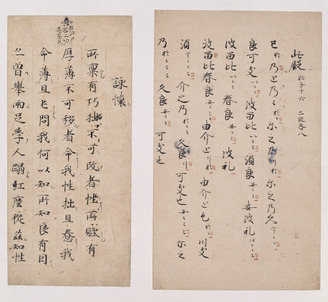
A poetry contest is an event in which two teams, the Right and Left, compose one poem each and the results are judged on their quality. They were popular events beginning in the Heian period (794–1192), primarily at the imperial court. Record of a Poetry Contest at the Empress’ Palace in the Kanpyō Era is one of the earliest surviving examples of a poetry contest. It was held by Empress Dowager Hanshi during the reign of Emperor Uda (887–899) and resulted in a total of 200 poems, twenty on each of five themes—spring, summer, fall, winter, and romantic love. The contest featured celebrated poets of the day, including Ki no Tsurayuki, Ki no Tomonori, Fujiwara no Okikaze, and the Buddhist priest Sosei. This manuscript copy was originally part of the fourth volume of the Poetry Contests in Ten Volumes passed down by the Konoe family. Poetry Contests in Ten Volumes is a compilation edited by Fujiwara no Yorimichi (992–1074) in the mid-Heian period. The compilation was left incomplete and was passed on to later generations as a draft collecting 46 poetry contests in ten volumes. As a result, traces of notes and corrections are visible throughout the manuscript.
The text presents each poem in two lines of powerful, refined calligraphy. The author of this copy also made numerous transcriptions and revisions to surviving poetry contests in Poetry Contests in Ten Volumes and is thought to have been a central figure in the compilation of poetry contests. For hundreds of years, Japan’s imperial family and nobility wrote poetry in elegant calligraphy to express their emotions and communicate with their lovers. From the 9th century, contests in which two teams vied for superiority by composing poems on the same theme became popular at the imperial court. The work on display records a contest organized by Princess Hanshi (833–900), who was the mother of Emperor Uda and later became empress dowager. The contest featured five themes — spring, summer, autumn, winter, and love — with twenty rounds for each, totaling two hundred poems. Participants included many of the era’s foremost poets, such as Ki no Tomonori and Ki no Tsurayuki. The contest’s record is an outstanding example of 11th-century calligraphy, when the beauty of the flowing Japanese script known as [kana] reached its peak of refinement.
— Museum description: Tokyo National Museum (CC BY 4.0), via ColBase / Japan Search.