Important Cultural Property

Cinerary urn (Excavated from the tomb of priest Dōyaku, Nara)
骨蔵器(奈良県佐井寺僧道薬墓出土)
Archaeological Objects · Nara, 8th centuryNara NM
Home › Browse › Archaeological Objects › Nara period › Objects excavated from the tomb of priest Dōyaku, Nara
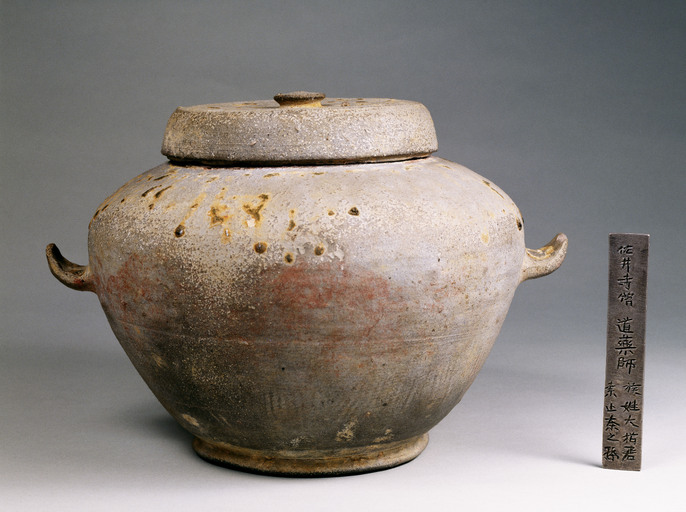
{i=>[boshi], content=>[When cinerary urns were buried in graves or tombs, information about the deceased—their name, origins, the date of their passing—was often written on an accompanying epitaph tablet (, ) or incised into the urn itself. This is the only known example of an epitaph tablet made from silver. Ōnara no Kimi and Dōyaku are two names inscribed on the tablet, though it is unclear who they were. Sa’idera Temple, which is also inscribed, was perhaps in the vicinity of Sa’i Jinja Shrine in the foothills of Mount Miwa. The inner and outer surfaces of the urn are painted in cinnabar.]} These objects were excavated from the slope of so-called Mt. Nishiyama in the north-east of the Nara Basin in 1958. Reportedly, the epitaph plate and the bones were kept in the cinerary urn, and the urn was covered with an unglazed sue type pottery, which was surrounded by a mound of pebbles. The rectangular epitaph plate is made of silver and thirty-six Chinese characters are engraved deeply on both sides of the plate.
According to the inscription of the epitaph, the buried person was Priest Dōyaku of Sai-dera temple, who was a grand-son of Ōnara-no-kimi Soshina and died on February 26, 714. Sai-dera temple was presumably today's Sai-dera temple in Chōanji-chō in Yamato-Kōriyama city. A different opinion claims that it was today's Sai-dera temple near Sai shrine located north-east of Ōmiwa shrine in Ōmiwa-chō in Sakurai city. Ōnara-no-kimi is presumably a member of a clan of foreign ancestry, who used to live in the area around today's Ichinomoto-chō and Nara-machi from where these objects were excavated. Nara shrine is located in that area. The cinerary urn is an unglazed pottery in the shape of a medicine pot which was commonly made during the Nara period. A pair of small handles are fixed to the shoulder part of the urn. This urn is painted with red clay. The thick layer of the color remains especially inside of the urn.
— Museum description: Nara National Museum (CC BY 4.0), via ColBase / Japan Search.