National Treasure

Sūtra box with design of lotus flowers
蓮唐草蒔絵経箱
Crafts · Heian, 12th centuryNara NM
Home › Browse › Crafts › Heian period › Nyoi (Crosier) with design of Hōsōge flower
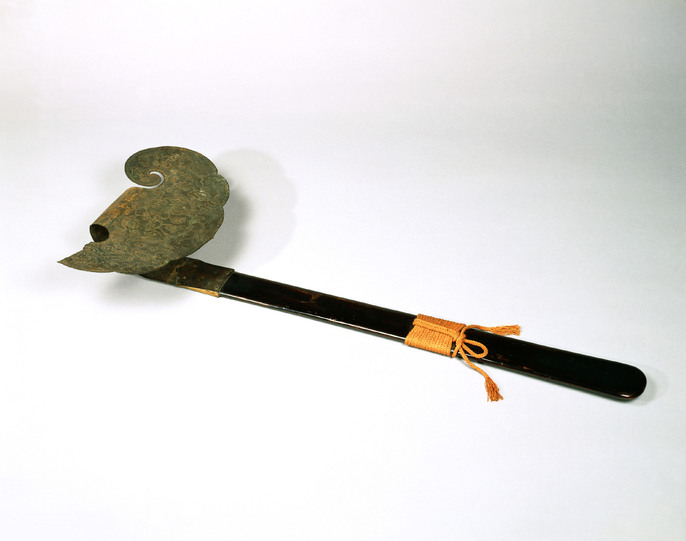
{i=>[hōsōge], content=>[This implement was held by a monk at occasions like Buddhist assemblies to affirm his dignity and authority. Designs of phoenixes, stylized arabesques (, ) and long-tailed birds were incised on the head portion of this scepter, which was then plated in silver and gold. The design is gorgeously executed.]} {i=>[nyoi, hōsōge], content=>[A , (‘As-You-Wish’ Scepter) is a ritual implement for formal occasions; priests sometimes hold them during Buddhist ceremonies. Initially, they were shaped like back-scratchers, though from the Heian period (794–1185) and on, they came to resemble objects like this one, with a broader head. Here, the head is gilt bronze incised with a design of phoenixes holding flowers in their beaks, mythical flowers (, ), and a butterfly.]} {br=>[[]], content=>[Nyoi-sticks, which were originally used for scratching one's back, were later used as crosiers of priests in Buddhism., The ornament at the end of this nyoi-stick is made of bronze in the shape of a cloud. If is decorated with needle-carvings and plated with gold and silver. The main motifs of the line-carved decoration are a mountain in the center and a pair of phoenixes holding hōsōge flowers and facing each other above the mountain. Hōsōge flowers are arranged symmetrically in a large area, and birds and butterflies are depicted between them. A pair of blue magpies with hōsōge flowers are also arranged symmetrically. The stick is made of wood and coated with black lacquer. The aesthetic taste of the Heian period is very well reflected in the delicate and graceful decoration.
Gold on the decoration and silver in the background are effectively arranged.]} {i=>[nyoi, ruyi, hōsōge, hōsōge], content=>[This type of Buddhist scepter (J. , ; Ch. , ) is a ritual implement held by speakers to add decorum to formal occasions like sermons, lectures, and ceremonies. The head of the scepter is made of a hammered bronze plate with gilding a nd silvering. The cloud-shaped head is wide with a foliate point in the center. Large and small arcs are rendered on either side, the ends of which spiral inward. The top end of the cloud gradually grows thinner as it bends toward the back, where it is attached to a black lacquered wooden shaft by a pointed metal fitting with openwork hearts. Bird feather-like patterns are incised along the edge of the cloud-shaped head. In the center, a pair of phoenixes face each other holding composite Buddhist flowers (, ) in their beaks. The flowers are symmetrically arranged to cover nearly the entire cloud-shaped head. Between the flowers, three birds and a butterfly are flying. Below the phoenixes, mountain-like motifs are sprouting flowers and leaves. The bent part of the head also has a pair of phoenixes and , flowers, and the metal fitting has the same flowers with a pair of mandarin ducks. The scepter makes complementary use of gold and silver to brilliant effect. The designs are incised in fine lines that were then gilt, with the remaining ground in between silvered. ]}
— Museum description: Nara National Museum (CC BY 4.0), via ColBase / Japan Search.


