National Treasure

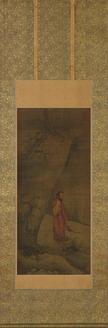
Zhou Maoshu Admiring Lotuses
周茂叔愛蓮図
Paintings · Muromachi, 1401–1500Kyushu NM
Home › Browse › Paintings › Kamakura period › Nirvana

This work depicts the scene of Nirvana (Buddha passing away) in Kushinagar, India. The Buddha lies on a pedestal between the twin sal trees. Around him are Bodhisattvas, monks, laymen and animals all in deep grief. At the rear of the pedestal is the flowing Battaiga river. Above the Buddha, his mother Maha is approaching him from the Trayastrimsa Heaven. The full moon is shining in the sky. This work is typical of Nirvana paintings, which became popular from the Kamakura period (1192–1333). However, there are several unique designs such as the Buddha’s opened eyes, and bees flying around the monk’s staff. Despite its large size of nearly three meters in length, the artist has been meticulous in painting the work. Bodies of the Buddha and Bodhisattvas were first painted in vermilion and the gold paint superimposed. Next, red outlines were drawn and the robes were decorated with finely cut gold leaves. Other people are depicted with dynamic ink outlines of powerful brushstrokes and the draperies of their robes highlighted. A wide variety of designs are depicted on their garments with various techniques such as gold paint decoration, raised coloring and color gradations. According to the text attached to the back of the work, the picture was painted by Myōson on the orders of Gyosei, a nun of Hokke-ji temple in Nara.
It was enshrined on February 13 in the third year of the Genkō era (1323). Myōson, a Buddhist painter, was active in Nara, particularly at Kōfuku-ji temple. He belonged to the studio (later known as Shōnami-za) founded by Sonchi during the early Kamakura period (1192–1333). Other known works by Myōson include the Nirvana Painting (Kamakura period, second year of the Shochu era [1325]) at Myōhō-ji temple in Hyōgo and the picture on the miniature shrine containing the Mahasri statue at Kōfuku-ji temple (Nambokuchō period, the third year of the Ryakuō era [1340], Imperial Cultural Property). All his works feature conservative depictions and bright colors. This work is particularly outstanding and might well be called his masterpiece. Along with its artistic value as a Buddhist painting representing the Kamakura period, the work also has a high historic value. The production year is clearly indicated along with the names of the painter and patron. After the Hokke-ji temple, the hanging scroll came into the hands of the Fujita family in Osaka and was purchased by this Museum in 2010.
— Museum description: Kyushu National Museum (CC BY 4.0), via ColBase / Japan Search.