National Treasure

Sūtra box with design of lotus flowers
蓮唐草蒔絵経箱
Crafts · Heian, 12th centuryNara NM
Home › Browse › Crafts › Kamakura period › Kakebotoke (Hanging round tablet) with image of ten Shintō deities
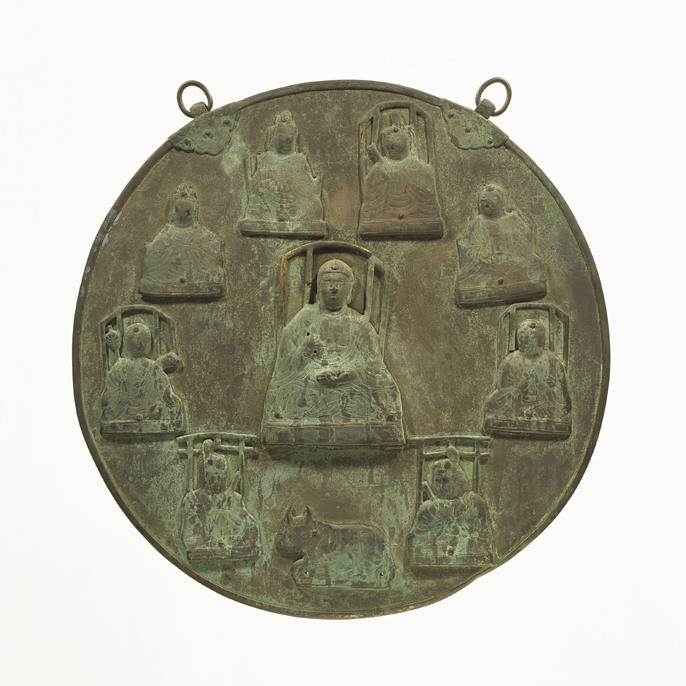
{i=>[Kakebotoke, kakebotoke], content=>[ are circular or square-shaped metal plaques with images of kami, or Shinto deities, and Buddhas affixed to them. They are hung within shrine buildings and temple halls. This one has the deities of the San’nōsha Shrine on Mount Hiei in Shiga. An engraving on the back tells us that this , is associated with a shrine or temple in Asodani, present-day Kumamoto prefecture.]} This rimmed bronze disk has two ornamental fittings and rings attached to it. Images of the Shinto deities, who are enshrined in ten sanctuaries of Sannō shrine in Shiga prefecture are depicted on bronze plates by hammering them into the plates from the back and riveting them to the disk. This is the original set of images of which the Mandala of Sannō shrine is comprised. Rivets are visible on the back of the disk, and the name of each deity, whose image is attached with that rivet, is written next to each rivet in line carving; the names are Ōmiya, Hachiōji, Shōjinshi, Ninomiya, Gyō-ji, Sannomiya, Kyakumiya, Jūzenji, Hayao, and Ushimiko. According to the inscription rendered by needle-line carving at the center of the backside, this mirror was made in 1218 by Taira-no-Kagetoshi. The name of the ten principal deities of Sannō shrine were documented by this disk. Considering of the date of production, this disk is one of the most noteworthy objects of Hie Sannō shrine. {i=>[kakebotoke, Kakebotoke, azukari dokoro], content=>[Resembling bronze mirrors, , are hanging plaques with images of deities either rendered in relief or attached in three-dimensional forms.
, are thought to have been derived from votive mirrors (metal disks with line engravings of Shinto and Buddhist deities). This example is a Sannō Mandala plaque. To make it, the deities venerated at ten Sannō shrines were hammered out in repoussé from bronze sheets. Details were added in line engraving, and they were then riveted to a circular bronze plaque. The plaque is edged along the rim, and flower-shaped metal fittings mounted with rings for hanging the plaque are set in two locations along the top. The particularly large figure in the center is Ōmiya in the guise of a monk. Clockwise from the upper right, the deities are: Hachiōji, Shōshinshi in the guise of a monk, th e deity of the second shrine in the guise of a monk, the monkey god Daigyōji, Ushi no Miko in the guise of an ox couchant, Hayao, Jū Zenshi appearing as the bodhisattva Jizō (Skt. Kṣitigarbha), t he goddess of Maroudo Shrine, and the goddess of the third shrine . Their names are inscribed on the back in places corresponding to each deity’s position. An inscription in the center reveals the plaque was produced on the 19th day of the 7th month of Kenpō 6 (August 11, 1218 [Julian calendar]) by Taira no Kagetoshi, an estate administrator (, ) in Asodani (now Sue, Asagiri, Kuma District, Kumamoto Prefecture). The inscribed date makes the plaque an important reference work for the early Kamakura period (1185–1333) in addition to its importance as an artifact associated with Hiyoshi Taisha/Sannō Shrine.]}
— Museum description: Nara National Museum (CC BY 4.0), via ColBase / Japan Search.


