National Treasure
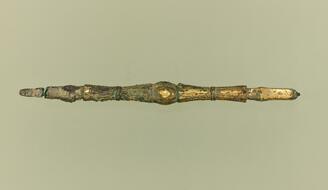
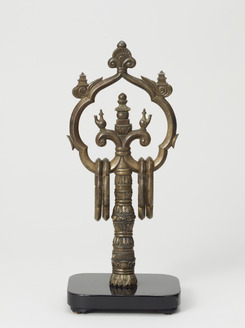
Shiketsu (Posts Erested at Four Corners of Alter to Rope off Sanctuary), Gilt bronze
独鈷
Metalwork · Heian, 12th centuryTNM
Home › Browse › Metalwork › Kamakura period › Hanging Plaque with the Bodhisattva Shō Kannon
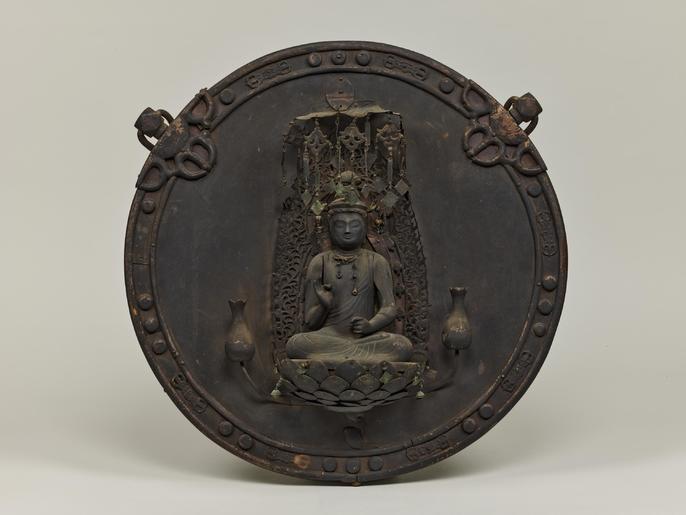
A small statue of a Buddhist deity is attached to this pendant plaque, which is shaped like a bronze mirror. This is a kakebotoke, or a Buddhist pendant plaque. It features a three-dimensional Buddhist image fixed to a round board 45 centimeters in diameter, with two metal hanging rings attached at the top. The object is predominantly made of gold-plated bronze, though the round board is made of wood and covered with a thin bronze plaque. A Buddhist deity sits on a lotus pedestal. The arrangement of the arms and the overall appearance reveals this to be Sho Kannon, one of the many forms of the Bodhisattva Kannon. We know roughly when this was made from the ink inscription on the back, which dates it to 1275. The shape of the finely-wrought Buddhist statue and metal fittings is characteristic of items produced during the latter half of the 13th century. Kakebotoke served as objects of worship and they were hung on the eaves or inner sections of temples and shrines.
Their predecessors were bronze mirrors with incised images of Buddhist or Shinto deities, which first emerged in the tenth century. There are several theories why images were incised onto bronze mirrors, but one involves the syncretism of Buddhism and Shintoism in Japan. Shinto deities were worshipped in Japan since ancient times and it was believed these deities resided in bronze mirrors. The arrival of Buddhism on Japan's shores led to a growing belief that each Shinto deity corresponded to a specific Buddhist deity. This led to the practice of depicting Buddhist deities on mirrors, which themselves represented Shinto deities. These images become more three-dimensional from the 12th century onwards. This trend led to the emergence of kakebotoke, whereby three-dimensional images were fixed onto a round board resembling a mirror.
— Museum description: Tokyo National Museum (CC BY 4.0), via ColBase / Japan Search.