Important Cultural Property
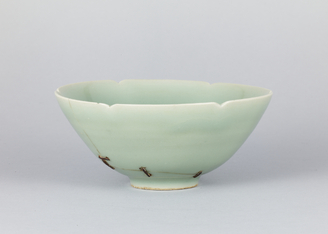
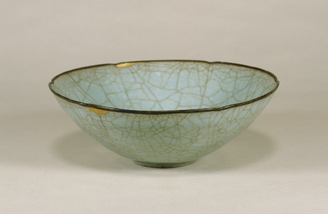
Bowl with a Foliate Rim, Named "Bakōhan"
青磁輪花茶碗 銘 馬蝗絆
Ceramics · Kamakura, 1101–1300TNM
Home › Browse › Ceramics › Kamakura period › Flower Vase in the Shape of a Cong Ritual Vessel
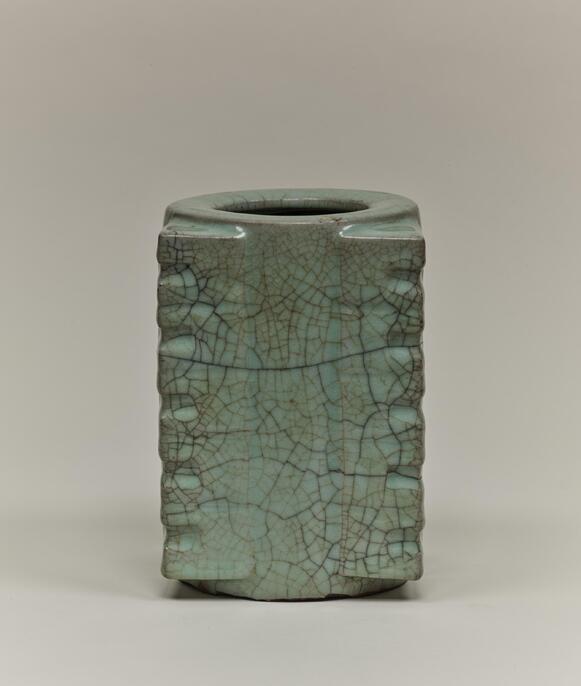
This celadon flower vase was made in a guan-yao, an official kiln where ceramics and porcelain were produced for the imperial court of the Southern Song dynasty, located in present-day Hangzhou city. The unusual fusion of rectangular shapes on a cylindrical body is modelled on an ancient Chinese jade implement known as a 'cong.' The guan-yao kilns produced many similar ceramic objects shaped like ancient jade artifacts. The deep color of the thick celadon glaze on dark gray clay makes a striking impression, as do the cracks in the glaze, formed by the different rate of shrinkage between the clay and the glaze. This work was owned by the Owari Tokugawa clan from the early Edo period to the start of the Showa era and it was used as a flower vase and a water jar. This ceramic container was designed to resemble an ancient ritual vessel made of jade. The tiny cracks in the glaze are an intentional decorative feature.
— Museum description: Tokyo National Museum (CC BY 4.0), via ColBase / Japan Search.